

Retail buyers do not choose a pepper grinder factory on price alone; they choose one that can protect margins, delivery schedules, and customer trust. A low unit cost can quickly lose its appeal if mechanisms jam, materials corrode, packaging fails, or fourth-quarter shipments arrive late. This article explains how procurement teams can evaluate a pepper grinder manufacturer with a practical, buyer-focused lens: factory versus trader differences, realistic MOQ and lead-time expectations, material and mechanism choices, electric grinder performance checks, and key commercial terms such as tooling fees. The goal is simple: reduce sourcing risk while building a product line retailers can confidently place on the shelf.
Why the Right Pepper Grinder Manufacturer Matters
Finding a capable pepper grinder manufacturer is an important priority for retail procurement teams. As the global kitchenware market expands, consumer demand for ergonomic, high-performance spice tools has intensified. Product failures, inconsistent grinding mechanisms, and supply chain bottlenecks directly impact retail margins and brand equity. When consumer return rates for kitchen gadgets exceed acceptable thresholds, the financial losses can quickly outpace any initial savings achieved through aggressive factory negotiations.
Manufacturer vs. Supplier Differences
Differentiating a direct factory from a trading company is the first step in vendor qualification. Trading companies typically add a markup to unit costs and can sometimes obscure the actual production origin, which may complicate traceability. However, trading companies also offer legitimate value for many buyers, such as lower effective Minimum Order Quantities (MOQs) and consolidated logistics for mixed-product shipments. Conversely, direct manufacturers maintain full control over tooling, injection molding, and assembly lines. This direct oversight enables immediate interventions during production bottlenecks and facilitates customized OEM (Original Equipment Manufacturer) or ODM (Original Design Manufacturer) modifications more directly. Furthermore, direct factories often possess dedicated engineering teams capable of interpreting complex CAD files, whereas working through traders can sometimes introduce communication delays when troubleshooting design flaws.
Key Commercial Signals to Check
Evaluating commercial signals requires analyzing specific operational parameters, though these vary dramatically by region, product complexity, and order history. A manufacturing facility typically mandates an MOQ to optimize automated production runs, often ranging from 1,000 to 3,000 units per SKU, though this is frequently negotiable. Standard lead times for initial orders generally fall between 30 and 45 days post-deposit, factoring in raw material sourcing and assembly. If a retailer requires custom injection molds, tooling fees apply; reputable manufacturers may amortize or refund these costs after cumulative orders reach a certain volume. Procurement officers must also assess overall production capacity, ensuring the vendor can effectively scale output to accommodate seasonal retail peaks in the fourth quarter.
What Retail Buyers Should Compare
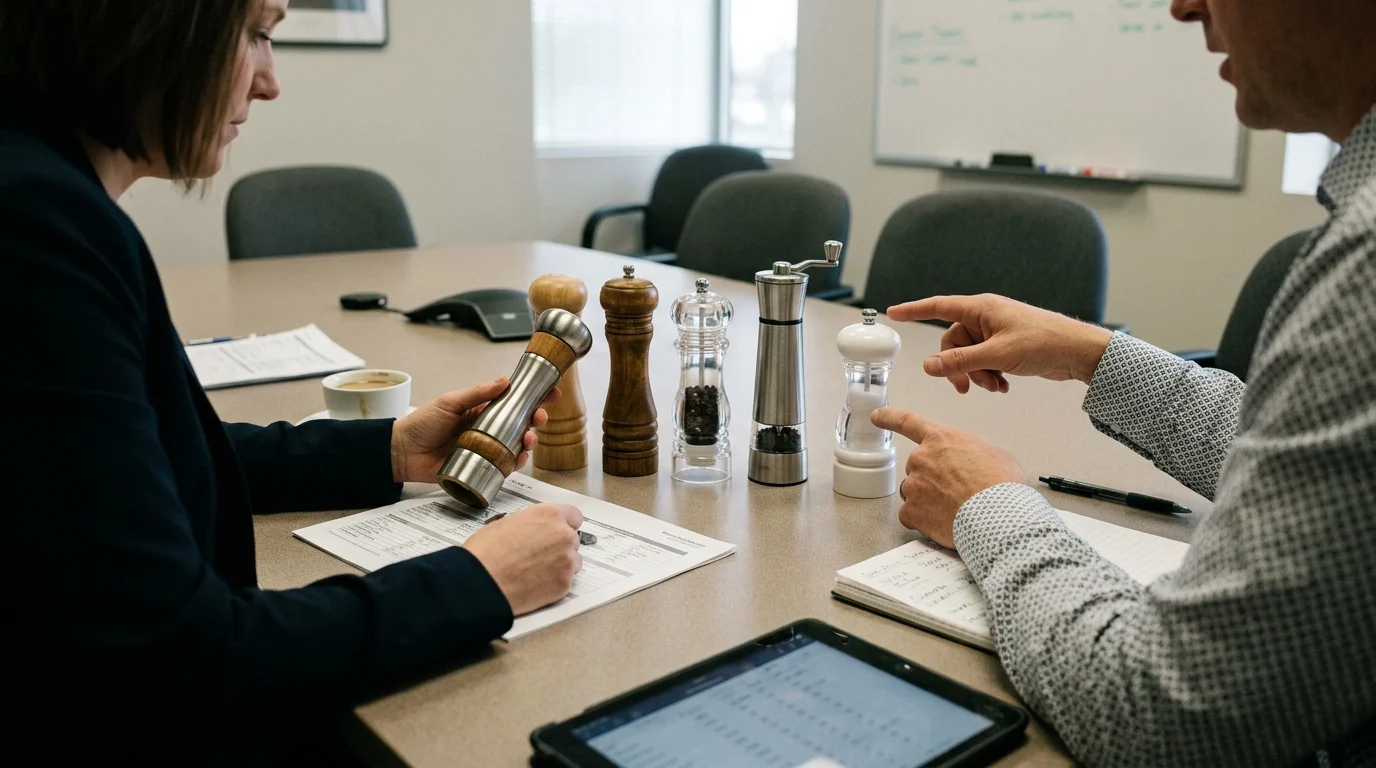
Once a shortlist of vendors is established, retail buyers must conduct comparative analyses of product specifications, material integrity, and regulatory compliance. These technical evaluations are vital to mitigate post-sale liabilities and ensure the product withstands daily consumer use.
Product Specifications and Materials
Core mechanism materials dictate longevity and grind consistency. High-alumina ceramic is a common standard for dual salt and pepper applications due to its corrosion resistance, whereas carbon steel offers sharpness tailored exclusively for peppercorns. Housing materials also vary significantly; a premium stainless steel pepper mill often utilizes 304-grade steel to prevent ambient kitchen rust. Advanced manual and electric models should feature a reliable coarseness adjustment knob with distinct tactile feedback, ensuring the gap between the inner and outer burrs remains stable under grinding pressure. When sourcing automated variants like an electric salt and pepper grinder, buyers must evaluate motor torque based on standard performance testing to prevent jamming, and ensure battery compartments are adequately sealed against moisture ingress.
Compliance, Quality Control, and Packaging
Compliance is essential in food-contact consumer goods. Grinders must pass FDA (United States) or LFGB (European Union) heavy metal and chemical migration testing. For motorized models, including any rechargeable pepper grinder, CE, FCC, and RoHS certifications are necessary to verify electronic safety and battery stability. Quality control protocols should adhere to standard Acceptable Quality Limit (AQL) parameters, commonly enforced at 2.5 for major defects and 4.0 for minor defects.
| Mechanism / Power Type | Primary Core Material | Lifecycle Testing Standard | Critical Regulatory Focus |
|---|---|---|---|
| Manual Rotary Burr | Alumina Ceramic | Standard Cycle-Test Protocols | LFGB / FDA Migration |
| Battery Operated (AA/AAA) | ABS / Acrylic Housing | Motor Endurance Testing | CE, RoHS, Torque Testing |
| USB-C Rechargeable | 304 Stainless Steel | Battery Charge/Discharge Cycles | Lithium Battery Drop Test |
How to Choose a Lower-Risk Manufacturer
Minimizing supply chain risk demands a systematic approach to vendor verification. Retailers should implement structured procurement frameworks to ensure the chosen manufacturer aligns with long-term commercial objectives and quality standards.
Factory Verification Steps
Effective factory verification extends far beyond reviewing basic business licenses. Buyers often request ISO 9001 certification and BSCI (Business Social Compliance Initiative) audit reports. However, it is crucial to understand that these certifications indicate the presence of management systems and social compliance, rather than guaranteeing final product quality. Additionally, because certificate fraud can occur in factory verification, buyers should independently verify these documents with the issuing bodies. Physical or third-party inspections should assess the actual condition of CNC machinery and automated assembly equipment. Procurement teams should also execute Non-Disclosure Agreements (NDAs) and verify that the factory has not previously infringed on patented grinder mechanisms, which could trigger customs seizures. Requesting rigorous pre-production samples of specialized items, such as a compact mini electric pepper grinder, allows buyers to verify motor consistency, acceptable acoustic levels based on standard noise testing, and housing tolerances before committing to bulk manufacturing.
Balancing Cost, Quality, and Reliability
Striking an optimal balance between unit cost and mechanical reliability is a primary procurement challenge. Free on Board (FOB) prices vary widely based on region, materials, and product complexity. For instance, basic acrylic manual models will cost significantly less than a sophisticated gravity pepper grinder featuring integrated tilt sensors and LED illumination. Buyers should negotiate standard payment terms—such as a 30% initial deposit and a 70% balance against the Bill of Lading—to maintain financial leverage throughout the production cycle. Allocating a cost buffer for During Production (DUPRO) third-party quality inspections and premium retail packaging helps ensure the final product meets consumer expectations. Furthermore, by consolidating shipments into Full Container Loads (FCL), retailers can optimize landed costs, noticeably reducing the per-unit freight expenditure compared to Less than Container Load (LCL) logistics.
Key Takeaways
- Verify whether a vendor is a direct manufacturer or trading company because this affects traceability, pricing, engineering support, and production control.
- Use MOQ expectations of 1,000 to 3,000 units per SKU as a baseline, but negotiate based on order size, customization, and production history.
- Plan initial orders around typical 30- to 45-day lead times after deposit, especially when preparing for seasonal fourth-quarter demand.
- Compare grinder mechanisms carefully, choosing ceramic for salt-and-pepper versatility and carbon steel for pepper-only sharpness.
- Assess electric grinder performance through motor torque, moisture sealing, and jamming resistance before committing to volume production.
- Clarify tooling fees, refund terms, and mold ownership in writing before launching custom OEM or ODM pepper grinder designs.
Frequently Asked Questions
What is the difference between a pepper grinder manufacturer and a trading company?
A manufacturer controls tooling, molding, assembly, and quality processes directly, while a trading company sources from factories and may add markup. Traders can still help with lower MOQs and consolidated shipments, but direct factories usually offer better traceability and faster engineering support.
What MOQ should retail buyers expect for pepper grinders?
Many factories require about 1,000 to 3,000 units per SKU to support efficient production runs. However, MOQ can often be negotiated based on product complexity, order history, customization level, and seasonal production schedules.
How long does a first pepper grinder order usually take?
Initial production commonly takes 30 to 45 days after deposit, depending on raw material availability, assembly complexity, customization, and factory capacity. Buyers should confirm timelines early, especially before fourth-quarter retail demand peaks.
Which grinder mechanism material is best for retail products?
High-alumina ceramic is suitable for both salt and pepper because it resists corrosion. Carbon steel is sharp and effective for peppercorns but is not ideal for salt due to corrosion risk.
What should buyers check in an electric pepper grinder?
Buyers should test motor torque, jamming resistance, battery compartment sealing, coarseness adjustment stability, and overall assembly quality. These factors affect performance, safety, returns, and consumer satisfaction.