
Freshly ground pepper has moved from a simple garnish to a measurable operational choice in restaurants, hotels, cruise lines, and catering programs. Because pepper’s aromatic oils begin oxidizing immediately after grinding—and a large share can fade within minutes—operators are rethinking how seasoning tools affect flavor, service speed, guest perception, and equipment costs. This article examines where pepper mills add the most value, from tableside presentation to prep-line consistency, while also addressing practical concerns such as grind precision, staff efficiency, sanitation, durability, and replacement rates. For foodservice teams, the right mill is no longer just tabletop décor; it is a small tool with real culinary and operational impact.
The Role of Pepper Mills in Modern Foodservice
In contemporary foodservice and hospitality, the transition from pre-ground spices to whole ingredients has redefined standard table settings and kitchen preparation protocols. The volatile aromatic compounds and essential oils in black peppercorns begin to oxidize immediately upon fracturing. Chemical analyses demonstrate that a significant portion of these crucial flavor notes—often 40% to 50% of volatile oils—dissipates rapidly within 30 to 45 minutes after commercial grinding. While many chefs still prefer pre-ground pepper for absolute consistency in certain complex sauces or high-volume batch cooking, preserving the essential compounds responsible for pepper's signature pungency and heat has led restaurants, cruise lines, and luxury hotels to increasingly integrate commercial-grade mills into daily prep and front-of-house operations.
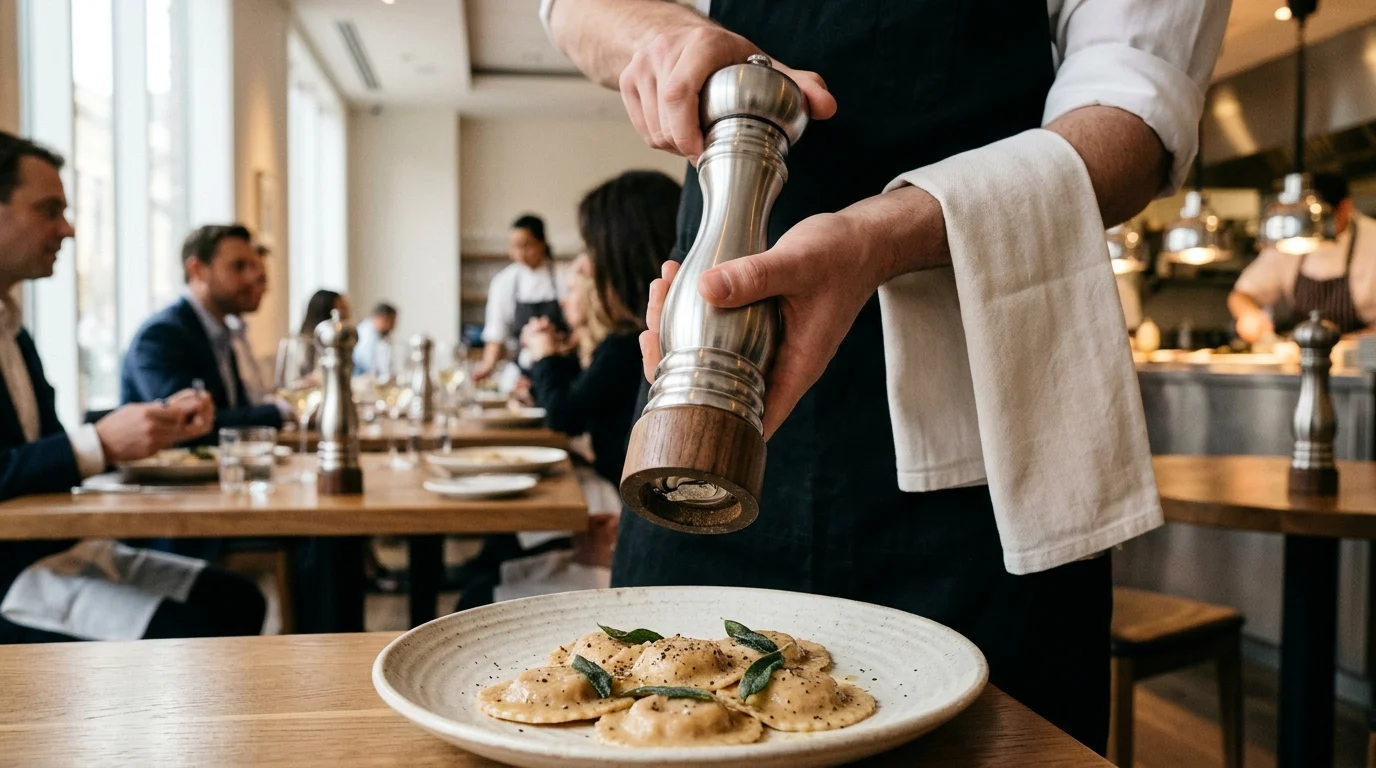
How Pepper Mills Enhance Tableside Service
Tableside service remains a cornerstone of premium hospitality, transforming a routine seasoning step into a high-touch guest interaction. When waitstaff are equipped with ergonomic, high-capacity grinders, the interactive finishing step boosts guest satisfaction and elevates the perceived value of the dining experience. However, operators must balance this high-touch interaction with the reality that manual tableside service may add 15 to 30 seconds per interaction, potentially slowing table turns during peak volume.
To support these elevated service models, procurement teams often evaluate examples from a commercial equipment supplier to ensure uniformity in aesthetics and mechanical reliability across multiple franchise locations. This consistency allows the visual cue of a premium mill to communicate an immediate, brand-wide commitment to culinary freshness, though managers must also account for common operational challenges like tableside mill theft or loss, which typically account for a 10% to 15% annual replacement rate and are often mitigated by staff-assigned equipment protocols.
Where Freshly Ground Pepper Adds Value
The culinary value of freshly ground pepper extends far beyond traditional fine dining steakhouses. Today, casual dining concepts, boutique hotels, and institutional catering operations utilize adjustable grind settings (typically offering 5 to 8 distinct coarseness levels) to match highly specific dish requirements. A coarse crack (roughly 1,000–1,500 microns) is absolutely essential for crusting proteins like steak au poivre or finishing a robust Caesar salad. Conversely, ultra-fine particles (200–400 microns) integrate seamlessly into delicate vinaigrettes, bisques, and complex sauces without leaving gritty residues.
Maintaining this micro-level precision during peak service hours requires evaluating options like a durable commercial grinder. Without commercial-grade durability, kitchen staff experience physical strain and inconsistent seasoning profiles, ultimately compromising the chef's original vision and slowing down the plating line.
Key Pepper Mill Specifications for Operators
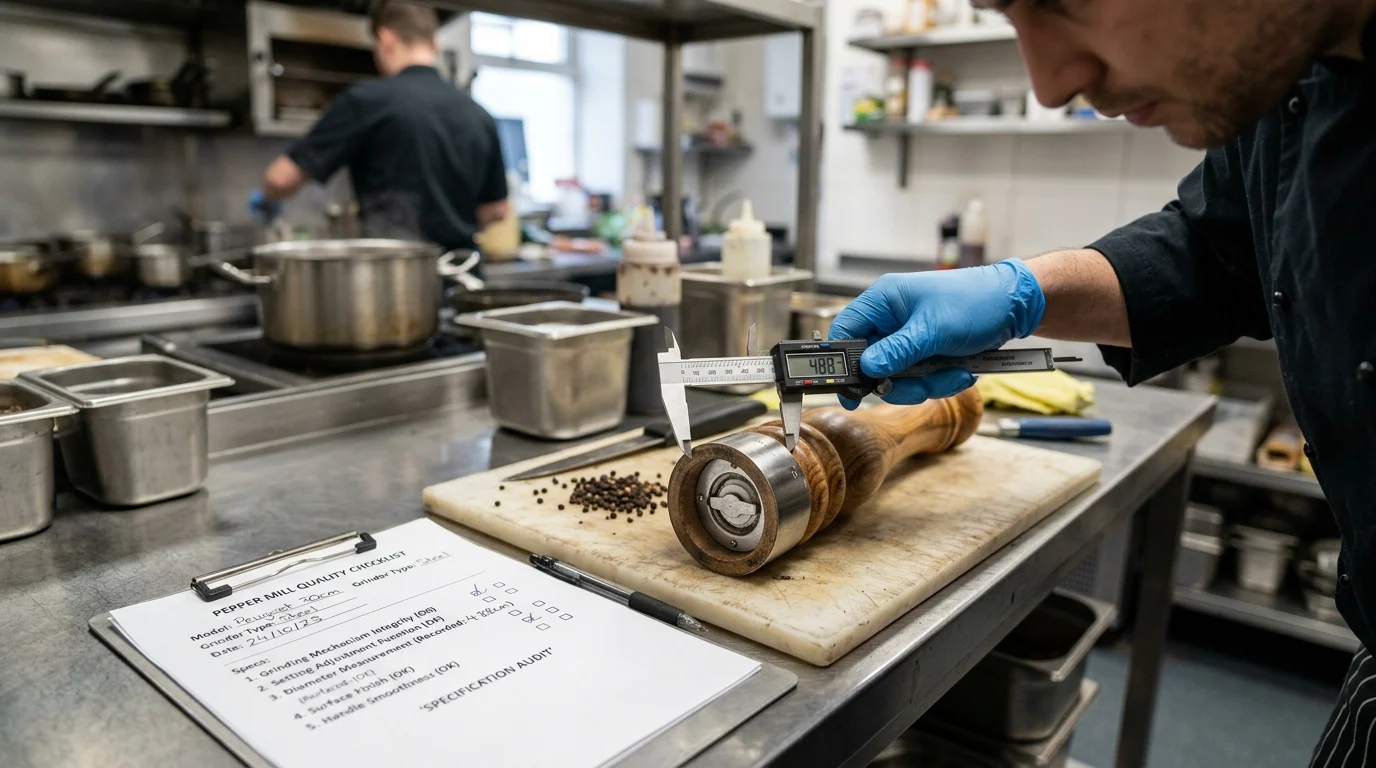
Selecting the appropriate milling equipment for a commercial environment requires a rigorous evaluation of technical specifications. Unlike residential models that are designed for intermittent, low-volume use, hospitality-grade mills must withstand continuous daily operation, frequent chemical sanitation, and occasional blunt impacts from being dropped on hard kitchen floors from standard 36-inch to 48-inch counter heights. Consequently, procurement teams must establish strict baseline parameters including NSF/ANSI 2 or equivalent food-safety certifications, housing durability under 1-meter drop scenarios, motor torque, and volumetric output targets of 0.2 to 0.5 grams per second.
Manual vs. Electric Pepper Mills
The debate between manual and electric mechanisms hinges on the specific operational environment and service style. Manual mills offer traditional aesthetics and a near-zero mechanical failure rate (typically <1% annually), making them ideal for standard dining room tables where guests prefer to control their own seasoning at their own pace.
Conversely, electric models provide one-handed operation and consistent torque, which is highly advantageous for fast-paced kitchen prep, high-volume buffet stations, or tableside service where the server must comfortably balance a plate with their free hand. However, operators must account for operational caveats; for instance, electric grinders can generate disruptive noise (often 60–70 decibels) in quiet fine-dining rooms, and facilities must implement proper battery disposal protocols. Modern electric units can achieve high-volume outputs of 15 to 25 grams of ground spice per minute, while maintaining a battery life—often powered by USB-rechargeable lithium-ion cells—sufficient for entire 8- to 12-hour service shifts (or 300+ actuations) per charge. Evaluating high-capacity electric units featuring gravity-activated mechanisms is a common strategy for operations outfitting large venues, as it reduces repetitive-motion fatigue for staff during extended shifts.
Grinder Mechanisms, Capacity, and Durability
The core of any mill is its grinding mechanism, which dictates both lifecycle longevity and performance consistency. High-carbon steel burrs offer exceptional sharpness, effectively shaving peppercorns rather than crushing them to release maximum oil. However, they are susceptible to rapid oxidation if exposed to moisture or accidentally used for hygroscopic sea salt. Advanced ceramic mechanisms, while slightly less sharp, are entirely corrosion-resistant and boast an extended commercial lifespan, though they can be fragile and prone to shattering if dropped repeatedly on hard commercial floors. Hopper capacity is another critical metric; commercial units typically require sufficient internal volumes (typically 50 to 100 grams, or 1.7 to 3.5 ounces) to minimize mid-shift refilling bottlenecks. Operators must also implement detailed sanitation protocols, noting which components are dishwasher-safe versus hand-wipe only.
| Mechanism Material | Yield per Revolution | Corrosion Resistance | Estimated Lifespan (Years) | Sanitation / Maintenance | Best Commercial Application |
|---|---|---|---|---|---|
| High-Carbon Steel | ~0.30g | Low | 3–5 | Hand-wipe only | Dry environments, dedicated pepper use |
| Advanced Ceramic | ~0.25g | Excellent | 5–7+ | Dishwasher-safe components | Humid environments, dual salt/pepper use |
| Zinc Alloy | ~0.15g | Moderate | 1–2 | Hand-wipe only | Low-volume or decorative front-of-house |
Selecting the optimal combination of housing materials and internal burrs is vastly simplified when reviewing options from a specialized equipment vendor to navigate the unique wear-and-tear dynamics of a commercial kitchen.
How to Choose and Manage Pepper Mills
Effective management of smallwares like pepper mills directly impacts an operation's bottom line, workflow efficiency, and brand perception. Strategic procurement goes well beyond evaluating the initial per-unit cost. It requires operators to factor in Total Cost of Ownership (TCO).
Key Takeaways
- Use whole peppercorns for finishing applications because 40% to 50% of volatile oils may dissipate within 30 to 45 minutes after grinding.
- Reserve tableside pepper service for moments where a 15- to 30-second interaction improves perceived value without disrupting table turns.
- Choose mills with 5 to 8 grind settings so kitchens can match coarse cracks to proteins and fine grinds to sauces or vinaigrettes.
- Procurement teams should prioritize commercial-grade durability, sanitation compatibility, ergonomic handling, and consistent output over residential-style aesthetics alone.
- Account for a 10% to 15% annual replacement rate from loss or theft by using staff-assigned equipment protocols and routine inventory checks.
Frequently Asked Questions
Why do restaurants use pepper mills instead of pre-ground pepper?
Freshly cracked pepper preserves more aroma, heat, and pungency because volatile oils begin dissipating soon after grinding. In many applications, mills help kitchens and servers deliver brighter flavor and a more premium guest experience.
How quickly does ground pepper lose flavor?
The article notes that 40% to 50% of pepper’s volatile oils can dissipate within 30 to 45 minutes after commercial grinding, which is why many operators prefer whole peppercorns for finishing and tableside service.
Do pepper mills slow down restaurant service?
They can if unmanaged. Tableside grinding may add 15 to 30 seconds per interaction, so operators should reserve it for high-value service moments or use efficient, ergonomic mills during peak periods.
What grind settings matter most in commercial kitchens?
Operators typically benefit from 5 to 8 grind levels. Coarse cracks suit steak, salads, and crusted proteins, while fine grinds work better in sauces, vinaigrettes, bisques, and dishes where texture must remain smooth.
What should buyers look for in a commercial pepper mill?
Key factors include durable housing, consistent output, sanitation compatibility, ergonomic handling, adjustable coarseness, food-safety compliance, and reliability under frequent daily use.