


Commercial air fryers are transforming modern kitchens. They deliver immediate operational advantages. Operators can save, on average, a third of their operating costs by switching to new technology. A Commercial Air Fryer helps kitchens achieve significant annual savings, often between $6,000 and $8,000 for a mid-size operation. This leads to quick payback periods. For instance, a Seattle gastropub saw a 30% drop in utility usage after replacing deep fryers with an Air Fryer. These appliances elevate menu offerings and boost kitchen efficiency.
Key Takeaways
- Commercial air fryers save money. They cut operating costs by a third.
- Air fryers cook food fast. This means customers wait less time.
- Air fryers use less oil. This makes food healthier.
- Air fryers make food crispy. They cook food evenly.
- Air fryers do many jobs. They can fry, roast, and bake.
- Air fryers save kitchen space. They are small and fit well.
- Air fryers are safer. They use less hot oil.
- Air fryers are easy to clean. They have parts that come out easily.
Unlocking Efficiency with a Commercial Air Fryer

Commercial kitchens constantly seek ways to enhance operational efficiency. A Commercial Air Fryer offers significant advancements in this area. It optimizes various aspects of food preparation and kitchen management.
Accelerated Cooking Cycles
Rapid Food Preparation
Air fryers dramatically reduce cooking times for many dishes. This speed allows kitchens to prepare food quickly. Chefs can turn around orders faster. This capability is crucial during peak hours. For example, kitchens often adjust traditional recipes for air fryer use.
The most common way to convert a traditional recipe for the air fryer is to reduce the temperature by 25° and 20% of the cooking time. While this works in most recipes, it is also important to check throughout the cooking process.
This adjustment means food cooks faster while maintaining quality.
Reduced Customer Wait Times
Faster cooking directly translates to shorter wait times for customers. Diners receive their meals more quickly. This improves customer satisfaction. Quick service also allows restaurants to serve more customers. This increases overall revenue potential.
Streamlined Kitchen Operations
Simplified Cooking Processes
Air fryers simplify many cooking tasks. They often feature preset programs and digital controls. Staff can easily operate these machines. This reduces the need for complex cooking techniques. It also lowers the chance of errors.
Minimized Manual Oversight
These appliances require less constant attention than traditional cooking methods. Staff can set the cooking parameters. The air fryer then handles the process. This frees up kitchen staff for other important duties. It improves overall labor efficiency.
Significant Energy and Cost Savings
Lower Operational Expenses
Commercial air fryers are cheaper to operate long-term. They use less energy than traditional deep fryers. This leads to substantial savings on utility bills.
Commercial air fryers are cheaper to operate long-term and use up to 50% less energy than traditional deep fryers.
These savings contribute directly to a restaurant’s bottom line.
Optimized Power Consumption
Air fryers consume less power compared to deep fryers. This optimized power usage reduces electricity costs. The table below illustrates the energy consumption differences.
| Cooking Method | Energy Consumption (Watts) | Energy Savings (%) |
|---|---|---|
| Deep Fryer | 2000 | N/A |
| Air Fryer (SAF-4567) | 1500 | 30-40% |
| Chicken Wings (Air Fryer vs. Deep Fryer) | N/A | 62% |
| French Fries (Air Fryer vs. Deep Fryer) | N/A | 45% |
| Fish Fillets (Air Fryer vs. Deep Fryer) | N/A | 50% |
Air fryers, such as the Cooking Air Electric Fryer, typically operate with wattages ranging from 1,400 to 1,700 watts and consume between 1.4 to 1.8 kWh per use. In contrast, deep fryers often operate at 2,000 watts and consume between 1.0 to 3.0 kWh per use, depending on their size and features. This indicates that air fryers generally use less power and energy per use. This efficiency makes them a smart investment for any commercial kitchen.
Elevating Food Quality and Consistency with a Commercial Air Fryer
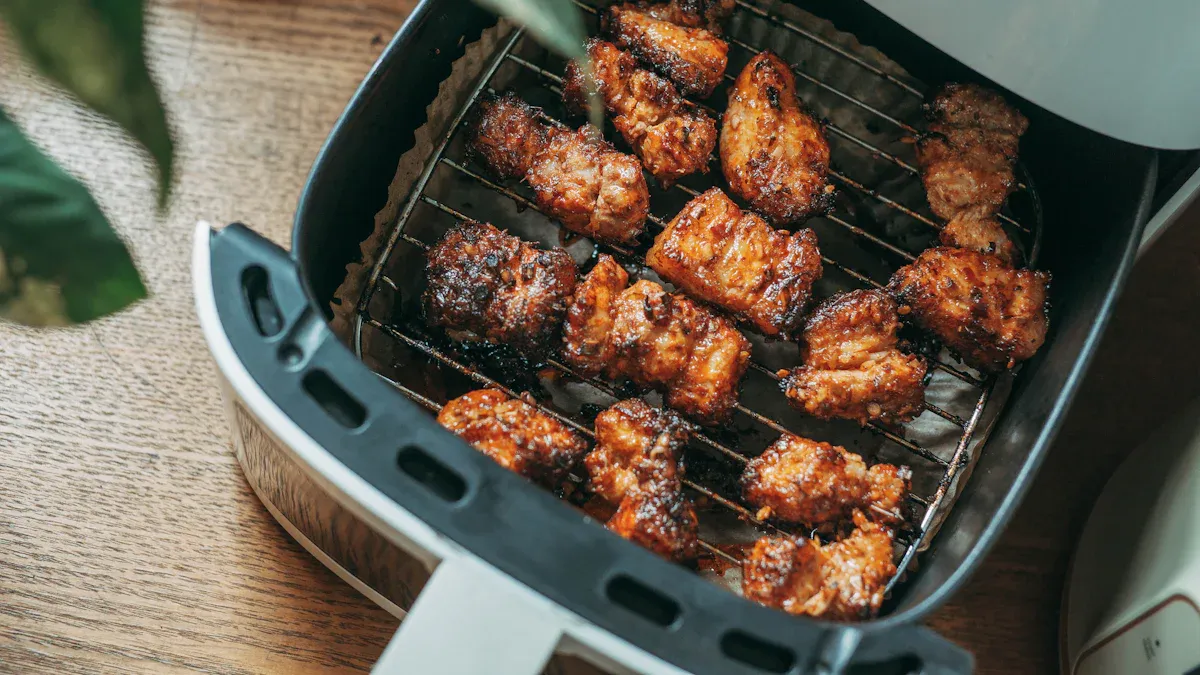
A commercial kitchen thrives on delivering high-quality, consistent food. A Commercial Air Fryer significantly enhances both aspects. It ensures every dish meets high standards.
Achieving Superior Texture
Uniform Crisping and Browning
Air fryers excel at creating desirable textures. They use a heating coil and a high-speed fan. This fan rapidly circulates hot air. This creates a ‘hot-air cyclone’ within a small space. The heat source is close to the food. This process quickly evaporates water molecules from the food’s surface. This rapid convection cooking speeds up browning and flavor development. It uses the Maillard reaction. This results in crispy, browned crusts. Cooking times are also faster compared to conventional ovens.
Air fryers use rapid air technology. This is a form of convective heat transfer. Hot air rapidly circulates inside a compact chamber. This process efficiently removes moisture from the food’s surface. Moisture removal is crucial for crisping. The concentrated heat and rapid air movement also help the Maillard reaction. This leads to browning. Conventional ovens also use convection. However, air fryers have higher fan speeds and smaller chambers. This makes them more effective at these processes. They have concentrated heat and faster air circulation.
In conventional ovens, evaporating moisture forms an insulating layer around food. This slows down drying and browning. Air fryers, like other convection ovens, overcome this. They use fans to continuously strip away this insulating vapor layer. This allows the food’s surface to dry and heat up faster. This leads to more even crisping and browning. Air fryers typically feature smaller ovens with higher fan speeds. This differs from the convection mode in a standard oven. Standard ovens often focus on even cooking rather than rapid crisping.
Desirable Mouthfeel
The superior crisping and browning achieved by air fryers create a highly desirable mouthfeel. Food cooked in an air fryer often has a satisfying crunch on the outside. It remains tender and moist on the inside. This contrast in textures enhances the eating experience. Diners appreciate the pleasant sensation.
Ensuring Consistent Culinary Results
Reduced Human Error
Commercial air fryers help reduce human error in food preparation. Many models offer multi-functionality and smart technology features. These include programmable settings and real-time monitoring. These features help commercial kitchens improve efficiency. They also provide consistent cooking results. Some smart air fryers can be controlled via smartphone apps. This allows users to optimize cooking processes. It enhances operational efficiency. The integration of voice control and automated settings further streamlines kitchen operations. This makes air fryers more user-friendly and efficient for foodservice businesses.
Standardized Product Output
Reduced human error directly leads to standardized product output. With programmable settings and precise temperature control, each batch of food cooks identically. This consistency is vital for maintaining brand reputation. It ensures customers receive the same high-quality dish every time they order.
Crafting Healthier Menu Options
Drastically Reduced Oil Usage
Air fryers offer a significant advantage for healthier cooking. They drastically reduce the amount of oil needed.
| Cooking Method | Typical Oil Used per Batch |
|---|---|
| Deep Fryer | Up to 2 quarts |
| Digital Air Fryer | 1 tablespoon or less |
Commercial air fryers can cut oil waste by up to 90% compared to deep fryers. Additionally, air frying reduces oil absorption by up to 90%. This means food contains much less fat.
Appealing to Health-Conscious Diners
The reduction in oil makes air-fried options very appealing to health-conscious diners. Air fryers help reduce fats and calories by 70% compared to conventional fryers. This aligns with a broader consumer trend towards healthy eating. Nearly 60% of U.S. households own an air fryer. This indicates a strong consumer preference. Growing awareness of health and wellness drives demand for air fryers. There is a shift towards healthier eating and reduced oil consumption. Global statistics from WHO and CDC highlight increasing obesity-related health concerns. This boosts demand for healthier cooking options. Consumers actively seek alternatives to traditional deep-frying. Air fryers are perceived as a healthier option. They use minimal or no oil. They cook food with hot air circulation. This growing health consciousness and desire for reduced oil consumption drive the surge in air fryer popularity.
Expanding Culinary Horizons with a Commercial Air Fryer
A commercial kitchen can greatly expand its menu options with a Commercial Air Fryer. This versatile appliance allows chefs to explore new cooking methods and cater to a wider range of customer preferences.
Versatile Cooking Applications
Frying, Roasting, and Baking Capabilities
Air fryers are not just for “frying.” They perform many cooking tasks. Kitchens can roast various foods. These include rib-eye steak, herb-roasted chicken, corn on the cob, and Brussels sprouts. They can even roast a whole chicken. Air fryers also excel at baking. Chefs can prepare cinnamon rolls, banana nut muffins, cookies, biscuits, mini muffins, and dinner rolls. They can also bake kale rolls, small lasagnas, fast focaccia, carrot cake, and pizza. This multi-functionality reduces the need for multiple pieces of equipment.
Efficient Reheating Functions
Beyond initial cooking, air fryers are excellent for reheating. They restore food to its original crispness and flavor. Popular items like pizza, fried chicken, and french fries reheat perfectly. This capability helps reduce food waste and improves service speed.
Fostering Menu Innovation
Experimentation with New Recipes
Air frying technology encourages chefs to experiment. They can adapt traditional recipes or create entirely new dishes. The precise temperature control and rapid cooking allow for creative culinary exploration. This leads to unique menu items.
Unique Dish Creation
Commercial kitchens use air fryers to develop innovative offerings. They bake mini pizzas, flatbreads, pastries, and lava cakes. They roast vegetables like Brussels sprouts, broccoli, and asparagus. Small cuts of meat, such as chicken thighs or pork tenderloin, also roast well. Air fryers can even grill chicken breasts, fish fillets, sausages, and halloumi cheese. Some kitchens use them for dehydrating foods. Examples include beef jerky, dried apple slices, and vegetable chips.
Accommodating Diverse Dietary Needs
Gluten-Free Preparation
Air fryers help kitchens cater to diners with dietary restrictions. They make gluten-free preparation easier. To prevent cross-contamination, kitchens can use a dedicated air fryer only for gluten-free food. They can label it clearly. Some models have two separate drawers. Kitchens can designate one drawer for gluten-free items. Alternatively, they can cook gluten-free food in the air fryer while preparing gluten-containing meals in a conventional oven. Thorough cleaning of the air fryer before each gluten-free use is also important.
Allergen-Friendly Cooking
These methods extend to other allergen-friendly cooking. Using separate appliances or designated sections minimizes risks. If sharing an oven, kitchens use separate trays. They place gluten-free food on the top shelf. When using fan or convection ovens, kitchens avoid cooking “dusty” gluten-containing foods simultaneously. They cover gluten-free food with tinfoil. Prioritizing safety ensures all diners can enjoy their meals without worry.
Operational Advantages of a Commercial Air Fryer
Commercial kitchens gain significant operational advantages from integrating a Commercial Air Fryer. These benefits extend beyond cooking performance, impacting space, equipment needs, and safety.
Maximizing Kitchen Space
Compact Footprint
Commercial air fryers offer a compact design. They occupy less counter space compared to traditional deep fryers or multiple specialized appliances. This smaller footprint is crucial for kitchens with limited room. It allows for more efficient use of valuable kitchen real estate.
Flexible Placement Options
Kitchens can place air fryers in various locations. Their self-contained nature and lack of open oil vats allow for greater flexibility. Operators can position them on countertops, worktables, or even on mobile carts. This adaptability helps optimize kitchen workflow and layout.
Reducing Equipment Dependency
Multi-Functional Appliance
A commercial air fryer serves multiple purposes. It reduces the need for several other kitchen appliances. This single unit can perform various cooking tasks. It bakes small batches of goods like mini pizzas, flatbreads, cookies, and muffins. It roasts vegetables such as Brussels sprouts, broccoli, and asparagus. It also roasts small cuts of meat like chicken thighs. The appliance provides grill-like results for chicken breasts, fish fillets, and sausages. It effectively reheats leftovers, including pizza and french fries, preventing sogginess. Some advanced models even offer dehydrating functions for making beef jerky or dried fruits.
Less Reliance on Traditional Fryers
Kitchens can significantly reduce their reliance on traditional deep fryers. The air fryer handles many items typically deep-fried. This shift minimizes the need for large, oil-filled fryers. It also reduces the associated costs and maintenance.
Enhancing Kitchen Safety
Minimized Oil Splatter Risks
Air fryers operate without large quantities of hot oil. This eliminates the risk of dangerous oil splatters and burns. Kitchen staff work in a safer environment. This reduces the potential for workplace accidents.
Cooler Operating Environment
Traditional deep fryers emit substantial heat into the kitchen. Air fryers, however, operate at a lower external temperature. They contain heat more efficiently. This contributes to a cooler and more comfortable working environment for kitchen staff. A cooler kitchen improves staff morale and productivity.
Durability and Maintenance of a Commercial Air Fryer
A commercial kitchen relies on equipment that performs consistently. Commercial air fryers offer both durability and straightforward maintenance. This ensures long-term reliability and efficient operation.
Robust Commercial-Grade Construction
Withstanding High-Volume Demands
Commercial air fryers are built to handle the rigorous demands of a busy kitchen. For high-volume food service, manufacturers construct these appliances with heavy-duty materials. Stainless steel is a common choice. This material ensures durability. Unlike consumer-grade models, professional versions operate continuously during peak hours. This necessitates robust construction. Kitchens should avoid designs heavily reliant on plastic. Plastic can indicate poor longevity and inconsistent performance.
Long-Term Reliability
High-quality units are typically constructed from heavy-duty stainless steel. This material is tough and resists corrosion. It is also easy to sanitize. These qualities contribute to a long operational lifespan. This holds true even under demanding commercial kitchen conditions. Investing in superior build quality ensures a reliable appliance. It handles the rigorous duty cycles of a busy restaurant. This minimizes costly downtime.
Simplified Cleaning Protocols
Non-Stick Surfaces
Many commercial air fryers feature non-stick surfaces. These surfaces make cleaning much easier. Food debris does not stick, allowing for quick wiping. Using soft cloths or sponges for non-stick surfaces prevents damage. Damaged surfaces can harbor bacteria.
Easily Removable Components
Cleaning protocols for commercial air fryers are straightforward. Kitchen staff can easily remove detachable components. These include baskets and trays. They clean these parts thoroughly with warm water and food-safe detergent.
- Unplug the air fryer and allow it to cool completely before cleaning.
- Remove detachable components like baskets and trays.
- Clean them thoroughly with warm water and food-safe detergent.
- Wipe internal surfaces carefully.
- Clean heating elements without using abrasive tools or soaking the unit.
- Ensure all parts are fully dry before reassembly.
- Conduct regular inspections during cleaning to identify worn or damaged parts.
Minimizing Operational Downtime
Efficient Maintenance Schedules
Regular cleaning prevents food contamination. It also avoids fire risks from grease buildup. This ensures compliance with hygiene standards. Daily cleaning of components like baskets, trays, and pans removes immediate contamination risks. Weekly deep cleaning addresses harder-to-reach areas. These include heating elements and fans prone to grease accumulation. Staff training on safe cleaning practices is crucial.
Quick Troubleshooting
The robust construction and simple design of commercial air fryers contribute to quick troubleshooting. When issues arise, their straightforward mechanics often allow for faster diagnosis and resolution. This minimizes operational downtime. Efficient maintenance schedules and proper staff training further support quick troubleshooting. This keeps the kitchen running smoothly.
Strategic Integration of a Commercial Air Fryer
Commercial kitchens maximize the benefits of an air fryer through careful planning. Strategic integration ensures smooth operations and enhanced menu offerings. This approach optimizes kitchen workflow and staff efficiency.
Seamless Workflow Integration
Optimizing Station Layouts
Kitchens position commercial air fryers strategically. They place them near prep areas or serving lines. This placement reduces movement and saves time. An optimized layout improves the flow of food preparation. It also enhances overall kitchen efficiency.
Complementing Existing Equipment
Air fryers work well with other kitchen appliances. They reduce the workload on traditional ovens and deep fryers. This balance creates a more efficient cooking environment. Air fryers can handle specific tasks, freeing up other equipment for different uses.
Effective Staff Training and Adoption
User-Friendly Controls
Commercial air fryers feature intuitive controls. Digital interfaces and preset programs make them easy to operate. Staff quickly learn how to use these machines. This reduces training time and increases confidence.
Best Practices for Operation
Proper training ensures staff use air fryers effectively. Training covers safe handling and cleaning procedures. It also teaches optimal cooking techniques. Staff learn to monitor food and adjust settings as needed. This ensures consistent results and extends the appliance’s lifespan.
Menu Development and Optimization
Adapting Recipes for Air Frying
Chefs successfully adapt many traditional recipes for air frying. They preheat the air fryer for even cooking and a crispy exterior. Chefs adjust cooking temperatures based on the food type. They avoid overcrowding the basket to allow proper air circulation. Staff rotate or flip food halfway through cooking for uniform results. They apply a light coating of oil to enhance texture and flavor. When cooking fatty foods, they add water to the drip tray to reduce smoke.
Highlighting Air-Fried Specials
Restaurants promote air-fried dishes on their menus. They highlight these items as healthier options. This attracts health-conscious diners. Special promotions or menu sections for air-fried foods can boost sales. This strategy showcases the kitchen’s commitment to quality and innovation.
Commercial air fryers redefine kitchen efficiency, food quality, and operational savings. These appliances offer undeniable value through their versatility and consistent performance. Investing in a commercial air fryer represents a strategic move. It modernizes and future-proofs kitchen operations. Kitchens achieve better results and save money. This technology ensures a competitive edge in the foodservice industry.
FAQ
What is a commercial air fryer?
A commercial air fryer uses rapid hot air circulation to cook food. It creates a crispy texture similar to deep-frying. This appliance offers a healthier alternative. It requires minimal oil.
How does a commercial air fryer save energy?
Commercial air fryers consume less power than traditional deep fryers. They cook food faster. This optimized power usage and quicker cooking cycles reduce overall electricity costs.
Can a commercial air fryer replace a deep fryer entirely?
A commercial air fryer can handle many items typically deep-fried. It significantly reduces reliance on deep fryers. However, some specialized dishes may still require traditional deep-frying methods.
What types of food can a commercial air fryer cook?
Commercial air fryers are highly versatile. They can fry, roast, and bake various items. Examples include chicken wings, french fries, vegetables, pastries, and even small cuts of meat.
Is a commercial air fryer easy to clean?
Yes, commercial air fryers feature non-stick surfaces and easily removable components. This design simplifies cleaning protocols. Staff can quickly clean baskets and trays, ensuring hygiene.
How does a commercial air fryer improve food quality?
It achieves uniform crisping and browning. The rapid air circulation creates a desirable crunchy exterior. Food remains tender inside. This process ensures consistent culinary results.
Are air-fried foods healthier than deep-fried foods?
Yes, air-fried foods are generally healthier. Air fryers drastically reduce the amount of oil needed for cooking. This significantly lowers fat content and calories compared to deep-fried alternatives.