
2026: 5 Steam Cleaner Strategies to Reduce Cleaning Costs
Why Steam Cleaner Cost Control Matters in 2026
As we look toward 2026, B2B wholesale buyers and facility managers face a perfect storm of shrinking operational budgets and rising compliance standards. If you import or distribute cleaning equipment, your clients are desperately looking to cut overhead without sacrificing hygiene. Steam cleaners have moved from a niche luxury to a core utility in professional cleaning arsenals.
Controlling costs in this category isn’t just about negotiating a cheaper unit price; it’s about understanding the machine’s entire lifecycle and its impact on the buyer’s bottom line. By optimizing specifications and sourcing channels, we can deliver genuine Operational cost reduction to our distribution networks.

Labor, chemical, and after-sales cost trends
Over the past three years, average commercial cleaning labor rates have jumped by roughly 15-20% globally, while industrial chemical costs have seen a 12-18% hike due to supply chain constraints. Steam cleaners neutralize both spikes. By using high-temperature vapor, clients eliminate the need for surface-specific chemical agents and significantly reduce scrubbing time. However, if you source machines with poor after-sales reliability, those labor savings are instantly wiped out by downtime and repair costs.
Segments with stronger margin protection
Not all B2B segments feel the pinch equally. Healthcare, food processing, and high-end hospitality offer much stronger margin protection for distributors. These heavily regulated sectors mandate chemical-free, high-sanitation protocols. By targeting these industries with commercial-grade steam equipment, importers can command premium pricing, insulating themselves from the race-to-the-bottom price wars found in the general janitorial sector.
How to frame total cost of ownership
When pitching a steam cleaner program, never focus purely on the FOB price. You must frame the Total Cost of Ownership (TCO) for buyers. TCO equals the initial purchase price plus maintenance and electricity, minus the massive savings in water (steam uses up to 90% less water than traditional washing) and chemical procurement. A machine that costs 20% more upfront but lasts three years longer with zero chemical dependency is an easy sell to a smart procurement officer.
How to Define Steam Cleaners for B2B Procurement
Before issuing a Purchase Order, you need to know exactly what you are buying. The term “steam cleaner” is notoriously broad, covering everything from $30 consumer mops to $3,000 industrial vapor systems. For B2B procurement, precision is everything.
Bringing in the wrong tier of equipment risks catastrophic warranty claims and alienates professional buyers. Categorizing these machines correctly helps build a highly targeted, profitable catalog.
Model types by use case
B2B steam cleaners generally fall into three buckets. First, handheld and compact cylinder models are ideal for auto detailing and light hospitality touch-ups. Second, mid-range continuous-fill commercial units are perfect for daily facility management. Finally, heavy-duty industrial vapor machines with integrated vacuums are designed for factory floors and deep grease removal. Always align your sourcing strictly with your target distributor’s end-user.
Key product and market terms
To navigate factory catalogs, you must speak the language. “Bar pressure” dictates the force of the steam (commercial units should hit 4 to 8 bar). “Dry vapor” means the steam contains only 5-6% water, crucial for cleaning mattresses or upholstery without leaving them soaking wet. “Continuous fill” refers to dual-tank systems that allow operators to add water without depressurizing and cooling the boiler.
Definitions that reduce sourcing errors
A common sourcing error is confusing a “steam mop” with a “hard surface steam cleaner.” A steam mop is typically a gravity-fed or low-pressure boiler pushing hot water into a pad. A true B2B steam cleaner utilizes a pressurized boiler to blast dirt out of grout lines and sanitize surfaces. Clearly defining these terms in your supplier RFQs prevents importing containers of underpowered, unsellable stock.
Steam Cleaner Specifications That Lower Operating Costs
The secret to a profitable B2B equipment program lies in the spec sheet. Chosen components directly impact how often the machine breaks, how fast it cleans, and how much electricity it draws.
Look past the glossy exterior and focus on the boiler, heating elements, and accessory quality. Smart specification choices lead to Energy efficient cleaner models that practically sell themselves to cost-conscious facility managers.
Boiler capacity, pressure, and heat-up time
For commercial use, stainless steel boilers are recommended over aluminum for superior calcification resistance. A 1.5 to 2-liter boiler hitting 4-6 bar pressure is the sweet spot for office and hospitality cleaning. Heat-up time is critical; if a machine takes 15 minutes to heat, you are paying a janitor to stand around. Look for 1500W-2000W elements that bring water to steam in under 7 minutes.
Accessories, tank size, and mobility features
Accessories are where cheap machines fail first. Specify nylon brushes for delicate surfaces and brass brushes for heavy grout and grill work. Tank size dictates runtime; a 2-liter continuous-fill tank offers unlimited runtime without cool-down periods. Mobility features like non-marking caster wheels and reinforced carrying handles are non-negotiable for professional cleaning carts.
How to compare performance and service life
| Component | Consumer Spec (Low ROI) | B2B Commercial Spec (High ROI) | Impact on Service Life |
|---|---|---|---|
| Boiler Material | Aluminum | Stainless Steel (AISI 304) | Resists scale, doubles lifespan |
| Hose Fittings | Plastic clips | Brass or heavy-duty quick-connect | Prevents leaks and pressure drops |
| Heating System | Single tank (cool down required) | Dual-tank (Continuous fill) | Eliminates element burnout from running dry |
How to Source the Right Steam Cleaner Supplier
Finding a factory is easy; finding a strategic manufacturing partner is hard. The best suppliers offer a blend of scalable production, rigorous quality control, and an understanding of western market compliance.
Look for partners that provide comprehensive R&D and supply chain solutions, giving B2B buyers a distinct competitive edge. Here is how you should evaluate your next supplier.
OEM, ODM, MOQ, and spare parts support
You need a supplier with strong ODM (Original Design Manufacturing) capabilities to help differentiate your private label. Look for flexible MOQs (Minimum Order Quantities)—ideally around 200-500 units for a trial run. Most importantly, demand a comprehensive spare parts catalog. A supplier that cannot quickly ship replacement O-rings, hoses, and brushes will kill your after-sales reputation.
Factory quality, lead times, and communication
A solid factory operates under ISO 9001 standards and maintains transparent lead times, typically 30-45 days for standard orders. Communication is key; your account manager should proactively advise you on material shortages or shipping delays. Test a supplier’s communication by asking complex technical questions about their boiler welding processes during the vetting phase.
How to assess supplier strengths
Assess a supplier by looking at their vertical integration. Do they inject their own plastics, or do they outsource everything? Factories that control their own tooling and injection molding generally have better quality consistency and faster troubleshooting capabilities. Also, review their export history to ensure they have experience navigating your specific target market.
Compliance and Quality Checks Before Importing
Having a container of high-margin equipment seized at customs because it lacks a basic electrical sticker is a costly mistake. Compliance isn’t just a legal hurdle; it’s a critical component of your brand’s trustworthiness.
Before wiring the final balance, ensure the goods meet the exact regulatory requirements of your region. Let’s break down the essential checks.
Required certifications by market
If importing into the EU, CE and RoHS certifications are mandatory; specifically check the Low Voltage Directive (LVD) test reports. For North America, UL or ETL listings are non-negotiable for commercial buyers—facility managers simply will not plug uncertified equipment into their buildings. For Australia, look for SAA approvals.
Electrical safety, durability, and warranty review
Because steam cleaners mix high voltage with water, electrical safety is paramount. Ensure the machines carry at least an IPX4 water resistance rating. Review the warranty terms with your factory: a standard B2B agreement should cover the boiler for at least 2-3 years, and electrical components for 1 year.
Pre-shipment inspection and sample testing
Never skip the pre-shipment inspection (PSI). Hire a third-party inspector to conduct an AQL (Acceptable Quality Limit) 2.5/4.0 check. They must perform a functional test on a random sample, checking for pressure consistency, thermostat accuracy, and potential water leaks at the hose joints before the goods are loaded onto the pallet.
How Packaging, MOQ, and Logistics Affect Landing Costs
The FOB price is only half the story. Your true margin is determined by your landed cost, which is heavily influenced by how efficiently your supplier packs the product.
Optimizing carton dimensions is vital because shipping “air” across the ocean destroys profitability. Smart logistics and packaging strategies are essential for maintaining Business efficiency in a volatile freight market.
Carton design, pallet efficiency, and accessory packing
Packaging should be designed to maximize container space. By nesting extension wands and utilizing custom-molded pulp instead of bulky styrofoam, you can often fit 15-20% more units onto a standard 40HQ pallet. Efficient accessory packing not only saves freight costs but also reduces transit damage, keeping your landed costs predictable.
MOQ and reorder planning by channel
Your MOQ strategy should align with your sales channel. If selling via B2B e-commerce, you might need smaller, more frequent LCL (Less than Container Load) shipments to maintain cash flow. If supplying national facility management chains, bulk FCL (Full Container Load) orders with strict 90-day reorder schedules will secure the best factory pricing and freight rates.
Freight options and spare-parts allocation
Always negotiate to have 1-2% of high-wear spare parts (like microfiber pads, O-rings, and brass brushes) included for free within your main container shipment. Shipping these parts later via air freight is prohibitively expensive. Consolidating parts with your main sea freight order drastically lowers localized warranty support costs.
Strategies to Reduce Steam Cleaner Costs Across B2B Channels
Surviving in the 2026 B2B landscape requires proactive cost-reduction strategies. You can no longer simply pass factory price increases onto distributors.
Instead, engineer savings into the product and the business model itself. By implementing these strategies, you can offer highly competitive pricing while expanding your own profit margins.
Standardize high-ROI specifications
Stop importing ten different variations of the same machine. Standardize your catalog around two or three high-ROI models—for instance, one compact 4-bar unit and one heavy-duty 6-bar continuous-fill unit. Consolidating SKUs increases purchasing power with the factory, lowers inventory holding costs, and simplifies marketing efforts.
Reduce consumable dependency
One of the best selling points for Cost-effective cleaning is the elimination of ongoing consumable costs. Ensure your machines use high-quality, machine-washable microfiber pads rather than proprietary disposable wipes. When clients realize they don’t have to buy expensive chemical refills or single-use pads, the lifetime value of the equipment skyrockets.
Build private label or exclusive assortments
Sourcing generic, off-the-shelf models puts you in direct price competition with every other importer. Work with a strong ODM factory to build a private label line. Even minor customizations—like an exclusive exterior color, a custom accessory bundle, or a slightly larger boiler—allow you to protect pricing and prevent buyers from cross-shopping your exact models elsewhere.
Strengthen spare-parts and distributor support
A robust spare parts program is a hidden profit center. By empowering local distributors with easy-to-access repair schematics and affordable replacement parts, you extend the machine’s lifecycle. This prevents total product replacements under warranty and builds fierce loyalty among B2B clients, who value uptime above all else.
Buyer Questions Before Choosing a Steam Cleaner Program
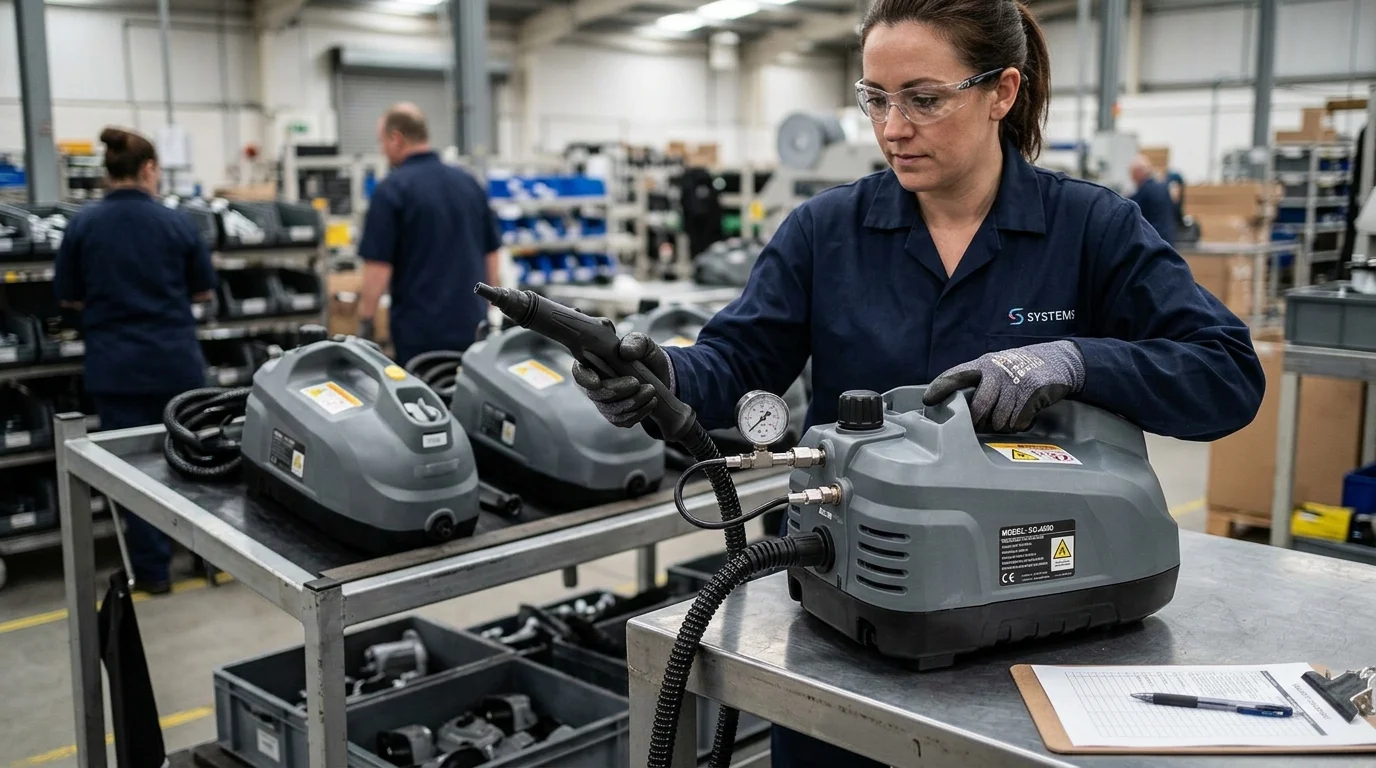
When sitting down with a new procurement team, the same critical questions frequently arise. Buyers want to mitigate risk before committing to a new equipment program.
Addressing these questions upfront clears the path to a successful, long-term partnership and ensures you are providing genuine Sustainable cleaning solutions.
What MOQ fits a new distributor or importer
For a new distributor testing the waters, an MOQ of 200 to 300 units is usually ideal. This volume is large enough to negotiate custom branding and secure decent sea freight rates per unit, but small enough to avoid tying up too much working capital if the market takes a few months to adopt the new line.
How to compare commercial and industrial models
The easiest way to explain the difference to buyers is the duty cycle. Commercial models (usually 110V/220V standard plugs, 4-6 bar) are built for 2-4 hours of intermittent daily use. Industrial models (often requiring 3-phase power, 8+ bar, with integrated vacuums) are designed for 8 hours of continuous, heavy-duty grime removal on factory floors.
Which sourcing decisions have the biggest cost impact
The single biggest cost impact comes from the choice of boiler technology. Opting for a cheap, single-tank aluminum boiler might save $30 at the factory, but it will cost hundreds in warranty replacements and lost distributor trust. Investing in a dual-tank, continuous-fill stainless steel system is the smartest sourcing decision for long-term profitability.
Related Reading: Cost-effective cleaning
Key Takeaways
- Wholesale sourcing and supply-chain implications for Steam Cleaner
- Specifications, compliance, and commercial terms buyers should validate
- Actionable recommendations for distributors and procurement teams