
How Can One Steam Cleaner Serve Hotel, Automotive, and Home Cleaning?
Why a Single Steam Cleaner Platform Can Serve Multiple Markets
B2B wholesale buyers and procurement managers often cite inventory fragmentation as a major headache. Stocking separate machines for hospitality, automotive, and residential cleaning ties up capital and warehouse space. However, from a manufacturing and sourcing perspective, the core technology behind a high-quality steam generator is fundamentally the same, whether melting grease off an engine block or sanitizing a resort bathroom.
Leveraging a single, well-engineered base unit allows distributors to drastically reduce SKU counts while maximizing market reach. Instead of managing three different Minimum Order Quantities (MOQs), you can source one robust base model and customize its application through accessory kits and private label packaging. This consolidates purchasing power and improves leverage during factory negotiations.
This modular strategy reshapes how importers build product portfolios. A base unit with a 4-bar pressure output and continuous refill boiler bridges the gap between light commercial and heavy-duty residential tasks by packaging shared mechanics for distinct buyer profiles.

Business case for a multi-application product
Higher volume on fewer SKUs equals better margins. Committing to a single platform achieves economies of scale faster, reduces spare parts inventory, simplifies after-sales training, and streamlines compliance testing. Instead of paying for CE or UL certifications on three distinct models, you pay for one.
Common buyer pain points across segments
Buyers consistently complain about machines losing pressure quickly, slow boiler heat-up times, and plastic accessories cracking under high heat. Because downtime costs money across all sectors, addressing these universal pain points with a single, high-quality build solves problems for multiple demographics simultaneously.
Cross-market demand in key regions
Demand for chemical-free cleaning is surging globally, but the applications vary. In North America, the automotive detailing sector is a massive driver for steam technology. In Europe, strict environmental regulations make steam a top choice for hospitality and municipal cleaning.
Text Chart: 5-Year Global Steam Cleaner Adoption by Sector
- Hospitality (Hotels/Resorts): 35% of market share (Driven by bedbug prevention and chemical-free mandates)
- Automotive Detailing: 28% of market share (Driven by water conservation and interior sanitization)
- Residential & Janitorial: 37% of market share (Driven by allergy awareness and deep cleaning)
What Makes a Steam Cleaner B2B-Ready
A massive gulf exists between cheap consumer steam mops and true B2B workhorses. When sourcing for commercial channels, look past the exterior and focus on internal components. A B2B-ready machine must withstand continuous daily operation without catastrophic pressure drops or thermal overload.
Evaluate the boiler material, heating element wattage, and safety valve tolerances. Stainless steel or high-grade aluminum boilers are non-negotiable. Furthermore, a versatile steam cleaner designed for commercial distribution usually features a dual-tank system, allowing users to refill without depressurizing and waiting for the unit to cool.
Procurement teams at hotel chains or auto shops evaluate the Total Cost of Ownership (TCO). A machine costing 20% more upfront but lasting three years longer with standard, replaceable O-rings will consistently win B2B contracts.
Core specifications buyers compare
Professional buyers scrutinize three main specs: pressure (measured in bars), temperature at the nozzle tip, and boiler capacity. A standard B2B model typically pushes between 4 to 8 bars of pressure and reaches internal boiler temperatures of 140°C to 170°C. Anything less, and you are selling a consumer toy that will result in high return rates.
Accessory kits for different use cases
Multi-market penetration relies on attachments. Automotive kits prioritize short, heavy-duty brass nozzles and triangular upholstery brushes. Hospitality kits feature wide floor attachments, microfiber pads, and window squeegees. Sourcing one machine allows you to create distinct SKUs simply by swapping the accessory box.
Product positioning by buyer type
Positioning dictates your pricing strategy. For auto detailers, market the machine as a revenue generator—something that cuts interior detailing time in half. For hotels, position it as a risk mitigation tool against allergens and pathogens. The hardware remains identical; only the marketing language and the bundled accessories change.
How to Compare Steam Cleaner Configurations
Not all form factors are created equal. The physical design dictates the ideal use case, container loading efficiency, and retail footprint. Wholesale buyers must balance target market performance requirements against the logistical realities of international shipping.
Machines generally fall into three tiers: handheld, canister, and heavy commercial carts. The canister style offers the best middle ground for a car detailing steam cleaner or a versatile hotel unit. It holds enough water for sustained use while remaining portable enough for a single operator.
Below is a comparison of standard configurations, crucial for planning container loads and calculating landed costs.
| Configuration | Avg. Pressure | Tank Capacity | Best Target Market | 40HQ Container Qty (Est.) |
|---|---|---|---|---|
| Handheld | 2-3 Bar | 0.2L – 0.5L | Light Home Use | 4,500+ units |
| Canister (Prosumer) | 4-5 Bar | 1.5L – 2.5L | Auto / Home / Hotel | 800 – 1,200 units |
| Commercial Cart | 6-10 Bar | 3.0L+ (Dual) | Industrial / Heavy Auto | 200 – 400 units |
Handheld vs canister vs commercial models
Handhelds are volume plays with thin margins, strictly for consumer retail. Commercial carts are high-margin, low-volume machines for industrial buyers. The canister model is the sweet spot for B2B distributors: it offers professional-grade pressure (usually 4+ bar) in a compact footprint, making it ideal for mobile detailers and hotel housekeeping carts.
Key features by application and channel
For janitorial supply channels, long power cords (5+ meters) and heavy-duty casters are mandatory. Mobile auto detailers prioritize continuous steam locking triggers and robust hose insulation to prevent burns during tight interior work.
When to standardize vs localize models
Standardize the internal boiler and pump across markets to keep MOQs low, but localize the exterior: voltage (110V for US, 220V for EU/Asia), plug types, and compliance labels. Avoid cheap plug adapters; always order localized power supplies directly from the factory.
What to Ask Steam Cleaner Suppliers
Finding a true manufacturing partner who understands B2B quality control is challenging. Supplier audits should focus on testing lines, not just showrooms. Steam involves high heat and pressure—a dangerous combination if manufacturing tolerances are loose.
Ask technical questions to weed out trading companies posing as factories. Inquire about heating element defect rates and pressure switch brands (e.g., CEME from Italy). Reliable suppliers know their internal components and maintain transparent supply chains.
Discuss capacity for custom molds and private labeling. When building a brand of hotel cleaning equipment, logos should be molded into the casing, not applied as cheap stickers that peel off in humid environments.
Factory capability and production basics
Always verify the factory’s production capacity and their inbound quality control (IQC) for raw materials. Do they test 100% of the boilers for pressure leaks before assembly, or just do batch sampling? For high-pressure steam, 100% individual testing of the pressure vessel is a mandatory requirement.
OEM, private label, and packaging options
Clarify the MOQ for color customization. Usually, factories require 500 to 1,000 units to change the injection plastic color. If you can’t meet that, ask if they offer standard OEM services like custom corrugated packaging and localized user manuals, which often have much lower thresholds.
Spare parts and supply consistency
A major B2B contract can be ruined if you can’t supply a replacement hose or a broken nozzle. Negotiate a spare parts agreement upfront. I recommend asking for 1% to 2% free easily-wearable spare parts (like O-rings, brushes, and microfiber pads) included with every container order.
Which Compliance and Quality Standards Matter
Navigating compliance is arguably the most critical step in importing electrical appliances. Steam cleaners are heavily regulated because they combine water, electricity, and pressurized vessels. Ignoring these standards isn’t just a customs risk; it’s a massive liability risk for your business.
For the European market, CE and RoHS are the absolute baseline, but you should also look for GS (Geprüfte Sicherheit) certification, which carries much more weight with German and Northern European B2B buyers. For North America, UL (Underwriters Laboratories) or ETL certification is mandatory if you want to sell to commercial entities, as their insurance policies often require certified equipment.
Don’t just take the factory’s word for it. Always request the actual test reports and verify them with the issuing laboratory. Factories sometimes show a CE certificate for a similar model, but customs authorities will flag your shipment if the model numbers on the machine don’t perfectly match the paperwork.
Required certifications by export market
Know your regional acronyms. North America demands UL/ETL and CSA (for Canada). Europe requires CE, LVD (Low Voltage Directive), EMC, and RoHS. Australia requires SAA approval. Selling a non-compliant machine to a commercial buyer can lead to immediate product recalls.
Safety and reliability checkpoints
The two most critical safety features are the thermal fuse (which cuts power if the boiler overheats) and the mechanical pressure relief valve (which vents steam if the pressure switch fails). During your factory audit or third-party inspection, these two components must be rigorously tested.
Documentation risks and customs delays
Ensure your commercial invoice, packing list, and product labels match perfectly. Steam cleaners generally fall under HS Code 8508 (vacuum cleaners, if they have a suction function) or 8479 (machines having individual functions). Using the wrong HS code can result in higher tariffs or your container being held at port.
How Logistics and After-Sales Impact Profitability
A common mistake new importers make is calculating their margin based solely on the FOB (Free on Board) price. In reality, the physical bulk of the product and the post-purchase support dictate your true profitability. Steam cleaners, especially canister and commercial models, take up significant cubic meters (CBM).
Optimizing packaging for container loading is essential. A box just two centimeters too wide drastically reduces units per pallet, driving up landed costs. Work with suppliers to engineer packaging so accessories nest tightly around the machine, eliminating dead air.
After-sales support is the other hidden cost. If you are selling a multi-purpose steam machine to commercial cleaners, they will break parts. Your profitability depends on having a streamlined process for diagnosing issues and shipping replacement parts without having to replace the entire unit.
Packaging and pallet planning
Request ISTA drop-test certified packaging. B2B machines are heavy, and standard cardboard won’t survive the journey from a Chinese factory to a US or EU distribution center. Double-wall corrugated boxes with custom EPE foam inserts are highly recommended over cheap EPS (Styrofoam), which crumbles and frustrates buyers.
Landed cost, warranty, and service support
Calculate your landed cost by adding the FOB price, sea freight, duties, port fees, and domestic warehousing. Factor in a 2-3% warranty buffer. Ensure your factory provides comprehensive exploded-view diagrams of the machine so your local service techs can easily identify and order specific replacement valves or switches.
Shipping considerations by product type
If you are importing models with built-in lithium-ion batteries (for hybrid cordless models, though rare in high-pressure steam), you will need MSDS and UN38.3 documentation. For standard corded models, shipping is straightforward, but moisture control inside the container is vital. Always insist on desiccant packs in every carton to prevent mold on the accessories during ocean transit.
How to Build the Right Channel Strategy
Having a great product is only half the battle; knowing where and how to sell it is what moves volume. Because a well-designed steam cleaner is inherently versatile, you can attack multiple verticals simultaneously, provided you tailor your channel strategy.
For the automotive sector, direct-to-dealer catalogs and specialized auto detailing trade shows yield the highest conversion rates. Detailers are highly visual buyers—they want to see video demonstrations of the steam cutting through cup-holder grime. Conversely, selling to the hospitality sector requires building relationships with large janitorial supply distributors who already have contracts with hotel chains.
Pricing strategies must also adapt. A machine bundled with specialized, high-end automotive tools can command a 20% premium over the exact same base machine bundled with generic home cleaning services accessories. It’s all about perceived value in the specific buyer’s niche.
Best-fit channels by target market
Segment your approach. Use online B2B marketplaces (like specialized wholesale portals) for general commercial cleaners. Use direct sales teams for hotel procurement boards, and leverage social media influencers in the detailing space to drive demand back to your distribution network.
Positioning, pricing, and feature bundles
Create tiered bundles: a “Basic Hotel Kit” with floor tools, and a “Pro Detailing Kit” with specialized lances and microfiber bundles. By keeping the base machine identical, you protect your inventory risk while capturing different price points and margins across various industries.
Balancing volume, margin, and repeat orders
The hardware sale gives you revenue, but the consumables give you profit. Encourage repeat orders by standardizing the connection fittings on your steam cleaner. This allows you to sell proprietary replacement brushes, descaling solutions, and premium microfiber pads to your B2B clients on a recurring basis.
Key Takeaways for Buyers
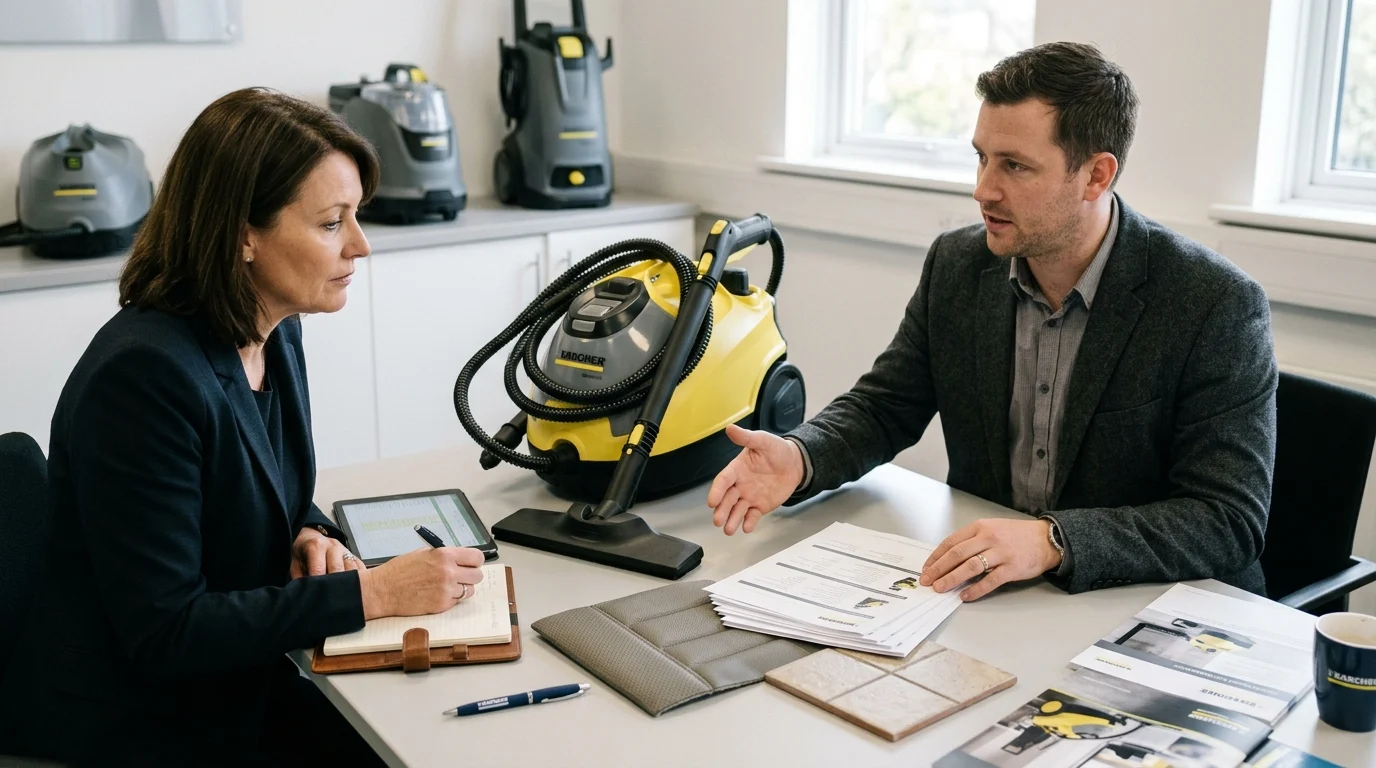
Sourcing a multi-purpose steam cleaner platform is one of the smartest ways to diversify your B2B catalog without overextending your supply chain. By focusing on core specs like boiler material, pressure output, and safety certifications, you can serve hotels, auto shops, and residential cleaners with a single, reliable machine.
This is where partnering with an experienced manufacturer makes all the difference. At Yisure, we pride ourselves on delivering robust, B2B-ready steam cleaning solutions. Our strong OEM/ODM capabilities mean we can customize accessory bundles and packaging to fit your exact market niche. With flexible MOQ options, strict quality control (including 100% pressure vessel testing), and comprehensive international certifications, we remove the supply chain risks so you can focus on scaling your sales.
Ultimately, your success comes down to choosing a platform that balances performance with logistical efficiency. Use the criteria discussed above to vet your options, and don’t hesitate to demand excellence from your manufacturing partners.
How to shortlist the right model
Focus on the canister prosumer/commercial models with 4+ bar pressure, continuous refill capabilities, and stainless steel boilers. These specifications provide the durability required for B2B applications while maintaining a manageable footprint for shipping and handling.
Questions to confirm before ordering
Before wiring a deposit, confirm the exact HS code, verify that all safety certificates are current and registered to the exact model number, and finalize the agreement on free spare parts (1-2% of order volume). Clarify the packaging drop-test standards to ensure safe transit.
Final evaluation checklist
- Does the machine meet local voltage and plug requirements?
- Are the accessories tailored to your specific target vertical (Auto/Hotel/Home)?
- Has the factory provided verifiable CE/UL/ETL documentation?
- Is the packaging optimized for maximum container loading?
- Do you have a clear after-sales support and spare parts plan in place?
Related reading: Versatile steam cleaner
Key Takeaways
- Wholesale sourcing and supply-chain implications for Steam Cleaner
- Specifications, compliance, and commercial terms buyers should validate
- Actionable recommendations for distributors and procurement teams