
How to Source a Knife Sharpener for Wholesale Success

Why the Right Knife Sharpener Matters for Wholesale Success
A knife sharpener isn’t just an accessory—it’s a high-margin anchor product. The global kitchen knife market is expanding at a ~6.0% CAGR, and every blade eventually dulls. For wholesale buyers, this represents a massive, recurring opportunity. Adding a high-performance sharpener to your catalog is a smart move to scale your offerings.
Succeeding requires more than picking the cheapest unit. A sharpener that sells out in big-box retail might flop in a high-end culinary catalog. Procurement professionals must align product specifications with target demographic needs to ensure high perceived value and healthy profit margins.
Strategic alignment can transform a stagnant SKU into a best-seller. Leveraging manufacturing expertise helps buyers navigate these choices, ensuring sourced products move off shelves. Here is how to assess your market and maximize returns.
Assess demand across retail, hospitality, and private label channels
Understanding your sales channel is crucial. Retail buyers seek attractive, compact designs with eye-catching packaging. Conversely, the hospitality sector demands rugged, utilitarian sharpeners built for commercial kitchen abuse. Private label brands require suppliers offering high customization in color, branding, and abrasive materials to stand out.
Compare margin potential by product segment
Sharpener types yield different margins. Basic manual pull-through models offer lower retail prices but drive massive volume, with margins often exceeding 60%. Electric sharpeners require higher initial investment and strict compliance, but command premium prices for 40-50% gross margins on higher dollar values. Whetstones occupy a niche with excellent margins due to low production costs and high artisanal value.
Case study: Improving sell-through with channel-specific SKUs
A European distributor struggled to sell generic manual sharpeners to restaurant clients because plastic housings cracked under commercial use. Pivoting to heavy-duty stainless steel models with replaceable tungsten carbide blades matched hospitality needs. Despite a 30% higher FOB price, sell-through doubled in the first quarter.
Knife Sharpener Types to Compare Before Buying Wholesale
Diving into kitchen tool sourcing without grasping product specifications risks failure. The market is segmented by technology, each serving a distinct purpose. Knowing these differences controls costs and targets customers accurately.
Buyers often get overwhelmed by variety. The key is evaluating core components—specifically abrasives and angle guides—which dictate manufacturing costs and end-user experience. Scrutinize these specs before committing to mass production.
Here are the primary categories, critical specs, and how they compare in wholesale environments.
Manual vs electric vs whetstone vs multi-stage models
Manual pull-through sharpeners drive volume; they are cheap to produce, easy to ship, and user-friendly. Electric models appeal to professionals but carry higher MOQs and complex warranties. Whetstones cater to enthusiasts, requiring skill but offering the sharpest edge. Multi-stage models (combining coarse diamond plates with fine ceramic rods) hit the retail sweet spot, offering a premium feel without electric price tags.
Key specifications: abrasive material, angle system, safety, and durability
Abrasive material dictates lifespan and cost. Tungsten carbide aggressively removes metal cheaply but can damage high-end knives. Diamond abrasives offer a premium, fast cut, while ceramic is essential for honing. Also evaluate the angle system (fixed vs. adjustable), grip ergonomics for safety, and housing durability (ABS plastic vs. stainless steel).
Compare type, target customer, MOQ, price band, and reorder rate
Here is a comparison of how these segments perform in wholesale procurement:
| Sharpener Type | Target Customer | Typical MOQ | Wholesale Price Band | Reorder Rate |
|---|---|---|---|---|
| Manual (Basic) | Budget Retail | 3,000 – 5,000 | $0.80 – $2.50 | High |
| Multi-Stage | Mid-Tier Retail | 1,000 – 3,000 | $2.50 – $6.00 | Medium-High |
| Electric | Premium / Pro | 500 – 1,000 | $12.00 – $35.00 | Low |
| Whetstone Sets | Enthusiast | 500 – 1,000 | $4.00 – $12.00 | Medium |
Case study: Reducing 12 models to 4 high-rotation SKUs
A homewares importer tied up capital stocking 12 sharpener variations. Analyzing sales data, they consolidated their catalog, cutting low-performing electrics and redundant models. Focusing on four multi-stage SKUs covering “good, better, best” price points slashed inventory holding costs by 40% while increasing category revenue.
How to Evaluate Knife Sharpener Suppliers Beyond Price
The lowest quote often carries hidden costs. Sourcing a tool designed to grind metal means poor manufacturing tolerances will ruin expensive kitchen knives, leading to disastrous reviews and chargebacks.
You need a supplier acting as a true partner, offering comprehensive OEM and ODM services to transition ideas from CAD to mass production. Evaluating suppliers requires examining their operational structure, quality control framework, and export history.
Beyond online profiles, ask hard questions about supply chains, custom packaging capabilities, and defect management before signing a proforma invoice.
Review OEM, ODM, customization, and production capacity
Determine if the factory is an assembler or has in-house molding and tooling. True ODM suppliers help design unique handles or integrate proprietary angle guides. Check monthly production capacity; a factory maxing out at 10,000 units will choke when Q4 orders spike to 50,000.
Verify samples, audits, lead times, and quality consistency
Never skip sampling. Test samples on actual knives for burr creation and edge refinement. Request factory audits (BSCI or ISO 9001) to ensure consistent manufacturing. Lock in standard lead times—typically 30 to 45 days—and ask how they handle raw material delays.
Assess MOQ flexibility, packaging support, and export experience
Great suppliers offer MOQ flexibility for pilot orders. They must possess extensive export experience, knowing how to pack master cartons for trans-Pacific journeys. Strong suppliers also provide in-house packaging support, from blister cards to premium magnetic boxes.
Case study: Avoiding a failed order through sample checks
A client almost bought 10,000 units from an unverified factory. Blind testing their sample revealed the “diamond” abrasive was standard sandpaper glued to a plastic wheel, wearing off after three uses. Rigorous sample verification saved the buyer a $15,000 loss.
MOQ, Packaging, and Private Label Options
Negotiating Minimum Order Quantities (MOQ) and designing packaging shape your brand identity. Treat packaging as an integral product component; in crowded retail, your box is your salesperson.
Operationally, packaging impacts freight costs and warehousing efficiency. Optimizing carton dimensions ensures you aren’t paying to ship empty air.
Whether selling via Amazon FBA or pitching supermarkets, your packaging strategy must be dialed in to maximize profitability.
Balance MOQ, carton quantity, and SKU count
Offering too many colors fractures volume. If a factory’s MOQ is 3,000 units, consolidate into one or two core colors to hit thresholds without over-leveraging cash. Optimize master carton quantities—packing 48 units instead of 24 significantly reduces dimensional weight during shipping.
Choose packaging formats for retail and e-commerce
Retail requires visibility; double-blister packs or open-faced color boxes let consumers see abrasive slots. E-commerce demands durability. For online sales, use ISTA-certified corrugated mailer boxes to prevent heavy sharpening mechanisms from breaking through during last-mile delivery.
Use branding, inserts, barcodes, and bundles to lift margins
Private labeling builds equity. Pad-print your logo onto the handle and include instructional inserts; teaching correct angles reduces complaints. Bundling a multi-stage sharpener with a cut-resistant glove or paring knife instantly bumps retail prices and margins.
Case study: Reducing damage claims with better packaging
An Amazon seller faced a 5% return rate because ceramic rods snapped during transit. Redesigning internal packaging from a plastic tray to a custom-molded EVA foam insert increased costs by $0.15 per unit but dropped damage rates to zero, saving thousands.
Quality, Compliance, and Testing Requirements
Quality control is the bedrock of customer satisfaction. If a sharpener underperforms, consumers know immediately. Rigorous testing protocols are essential before goods leave the factory.
Compliance is equally critical for electric sharpeners or models with suction cups and food-grade plastics. Partnering with knowledgeable manufacturers makes navigating these requirements seamless.
Implement strict inline and pre-shipment inspections to guarantee performance. Here is how to structure quality and compliance checks.
Check sharpening performance, abrasion consistency, and durability
QC teams must perform functional tests, including the “paper test” to verify edges. Check abrasion consistency—ensure even diamond coatings and unchipped ceramic rods. Perform cycle testing on handles and non-slip bases to ensure they withstand heavy downward pressure.
Confirm compliance documents for target markets
Manual sharpener compliance is light, but ensure plastics are free of restricted phthalates (REACH, Prop 65). Electric sharpeners require CE, RoHS, or UL certifications. Always verify actual lab reports rather than taking a supplier’s word.
Plan pre-production, inline, and pre-shipment inspections
Implement standard AQL inspections (1.5 major / 4.0 minor). Pre-production checks ensure correct raw materials. Inline inspections catch assembly errors like misaligned angle guides early. Pre-shipment inspections verify packaging, barcodes, and functionality.
Case study: Cutting returns with added QC tests
A buyer noticed sharpeners leaving deep scratches on knives. A factory audit revealed the V-slot angle was too tight, causing plastic housings to rub blades. Implementing an inline clearance test with a chef’s knife template corrected the molding, eliminating scratches and returns.
Logistics, Costing, and Inventory Planning
Procurement ends when goods sit profitably in your warehouse. Freight and logistics can easily wipe out cheap FOB price savings.
Effective inventory planning requires understanding landed costs and lead times. Stockouts during Q4 leave money on the table, while over-ordering ties up working capital.
Strategically planning shipments and understanding true costs maintains healthy cash flow. Here is the logistical math to master.
Calculate landed cost by SKU
Never price retail products based on FOB cost. Calculate landed cost, including factory price, domestic transport, freight, customs duties, broker fees, and marine insurance. This final number accurately projects profit margins.
Choose shipping, replenishment, and safety stock strategies
Knife sharpeners are dense, making air freight prohibitively expensive except for emergencies. Plan for ocean freight (LCL or FCL). With 30-45 days for production and 30 days for shipping, establish a 90-day replenishment cycle. Keep a 30-day safety stock buffer against port strikes or material shortages.
Compare FOB, landed cost, and target margin
For a premium multi-stage sharpener:
- FOB Price: $3.50
- Freight & Duties: $0.80 per unit
- Landed Cost: $4.30
- Wholesale Target Price: $8.60 (50% margin)
- Retail MSRP: $19.99
Understanding this breakdown ensures sufficient margin for B2B wholesale discounts while remaining profitable.
Case study: Improving cash flow through shipment consolidation
A distributor ordered kitchenware from three factories, paying high LCL fees. Routing all goods to a single consolidation warehouse in Ningbo and combining SKUs into one 40HQ container reduced per-unit shipping costs by 22%, improving cash flow.
Build the Right Assortment for Each Sales Channel
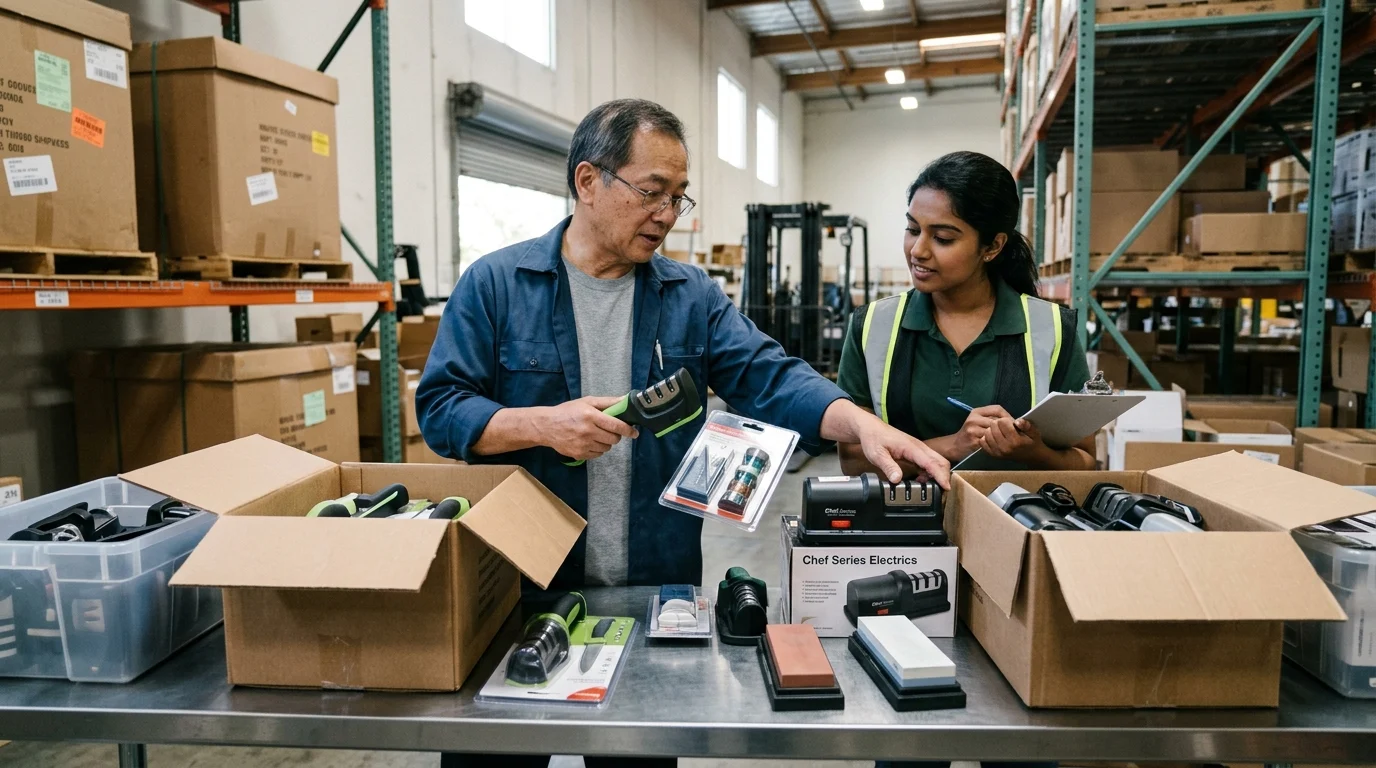
The best product won’t sell if it doesn’t fit the channel. Building the right assortment matches features, price points, and presentation to buyer psychology.
Curating a tailored catalog positions you as a category expert. Focus on achieving efficient sharpening solutions that resonate with specific audiences.
Here is how to segment sharpeners and build an assortment maximizing reach across retail and commercial landscapes.
Match features to supermarket, hardware, hospitality, and online channels
Supermarkets need impulse buys: small, colorful manual sharpeners under $10. Hardware stores suit rugged, tool-like sharpeners for DIYers. Hospitality requires NSF-certified commercial models processing dozens of knives hourly. Online channels thrive on feature-rich, multi-stage models that photograph well.
Create a good-better-best assortment
Avoid overwhelming buyers; offer three distinct tiers. “Good” is a basic 2-stage manual sharpener. “Better” is an ergonomic 3-stage sharpener with premium materials. “Best” is an electric model or high-end whetstone. This psychological pricing drives consumers toward the mid-tier option, where margins are highest.
Support sell-through with packaging claims, demos, and displays
Help retailers sell by including clear packaging claims like “Restores dull edges in 5 seconds.” For brick-and-mortar clients, offer branded Countertop Display Units (CDUs) holding 12 or 24 sharpeners. Small video displays showing the sharpener in action drastically increase impulse purchases.
Case study: Increasing repeat orders with channel-fit specs
A client targeting outdoor stores initially sold standard kitchen sharpeners. Pivoting to compact, high-visibility orange sharpeners with built-in carbide slots and fold-out diamond rods for hunting knives matched outdoor channel specs, boosting B2B repeat orders by over 60%.
FAQ and Next Steps
Wrapping up this procurement guide, here are common questions. Sourcing is an ongoing process, and mitigating risk is key.
Standardizing your approach and avoiding pitfalls turns knife sharpeners into a reliable revenue stream.
What is a reasonable MOQ and when should you negotiate it?
Standard factory MOQs for custom-branded manual sharpeners are 2,000–3,000 units. If buying off-the-shelf designs and only customizing packaging, negotiate down to 1,000 units for trials. Ask to piggyback on larger production runs for lower MOQs.
How many SKUs should you launch with?
Start lean. Launch with 3–4 carefully selected SKUs covering a good-better-best strategy. This minimizes capital risk while providing variety to test customer resonance. Expand the catalog once you have concrete sales data.
What sourcing mistakes should buyers avoid?
The biggest mistake is ignoring abrasive quality to save cents. Cheap carbide shreds edges, and fake diamond dust rubs off. Failing to test ergonomics is another error; small handles cause knuckles to hit counters, leading to terrible reviews.
Decision checklist for supplier selection and risk control
Before issuing a Purchase Order, use this checklist:
- Have I tested a physical sample on actual knives?
- Does the supplier have verifiable quality audits and export experience?
- Are abrasives specified in the contract (e.g., 600-grit diamond)?
- Have we agreed on an AQL inspection standard prior to shipping?
- Is packaging optimized for retail display and transit durability?
Related reading: high-performance sharpener
Key Takeaways
- Wholesale sourcing and supply-chain implications for Knife Sharpener
- Specifications, compliance, and commercial terms buyers should validate
- Actionable recommendations for distributors and procurement teams