

In a busy foodservice operation, a pepper grinder is not a decorative afterthought—it is a small tool with measurable effects on speed, consistency, flavor, and labor comfort. When a kitchen moves through kilograms of peppercorns each week or serves hundreds of covers per shift, domestic mills can become a weak link, causing uneven seasoning, staff fatigue, and premature equipment failure. This guide explains how to evaluate commercial-grade pepper grinding equipment by service model, capacity, burr design, ergonomics, noise, moisture resistance, and output demands so buyers can choose tools that support both front-of-house presentation and back-of-house efficiency.
Assess Commercial Pepper Grinding Needs
Selecting the optimal pepper grinding equipment for a commercial kitchen goes beyond aesthetics; it is a practical decision that impacts culinary consistency, service speed, and staff ergonomics. Transitioning from domestic tools to commercial-grade hardware requires a careful look at daily workflow and output demands.
Define High-Volume Use
Defining high-volume use in a commercial setting often relies on illustrative benchmarks. As a general rule of thumb, an establishment processing 2.5 to 5 kilograms of whole peppercorns weekly, or serving more than 500 covers per service, operates in a high-volume tier. At this scale, standard domestic mechanisms quickly degrade, leading to inconsistent particle sizes, stripped gears, and eventual mechanical failure.
Furthermore, high-volume environments must account for the thermal dynamics of grinding. Continuous friction can heat the internal burrs, prematurely releasing volatile essential oils and dulling the pepper's flavor profile before it reaches the plate. Commercial units are engineered with larger grinding mechanisms designed to process spices quickly while keeping heat generation low.
Match Grinder Type to Service Model
The specific service model dictates the necessary equipment profile. For front-of-house (FOH) table-side service, a reliable pepper grinder for restaurants should balance visual appeal with rapid, jam-free dispensing. Waitstaff performing frequent grinds per shift benefit from smooth-action mills that reduce hand fatigue. For electric FOH units, a common rule of thumb is to seek units operating under 60 dB to avoid disrupting the dining experience.
Conversely, back-of-house (BOH) operations prioritize raw efficiency and durability. Line cooks need grinders that operate swiftly—often with one hand—while managing the environmental hazards of a hot, steamy kitchen. Look for units with an ingress protection rating of IPX4 or better to shield internal components from humidity and splashing. Matching the grinder type to the exact service station prevents bottlenecks and keeps service moving efficiently.
Compare Key Pepper Grinder Specifications
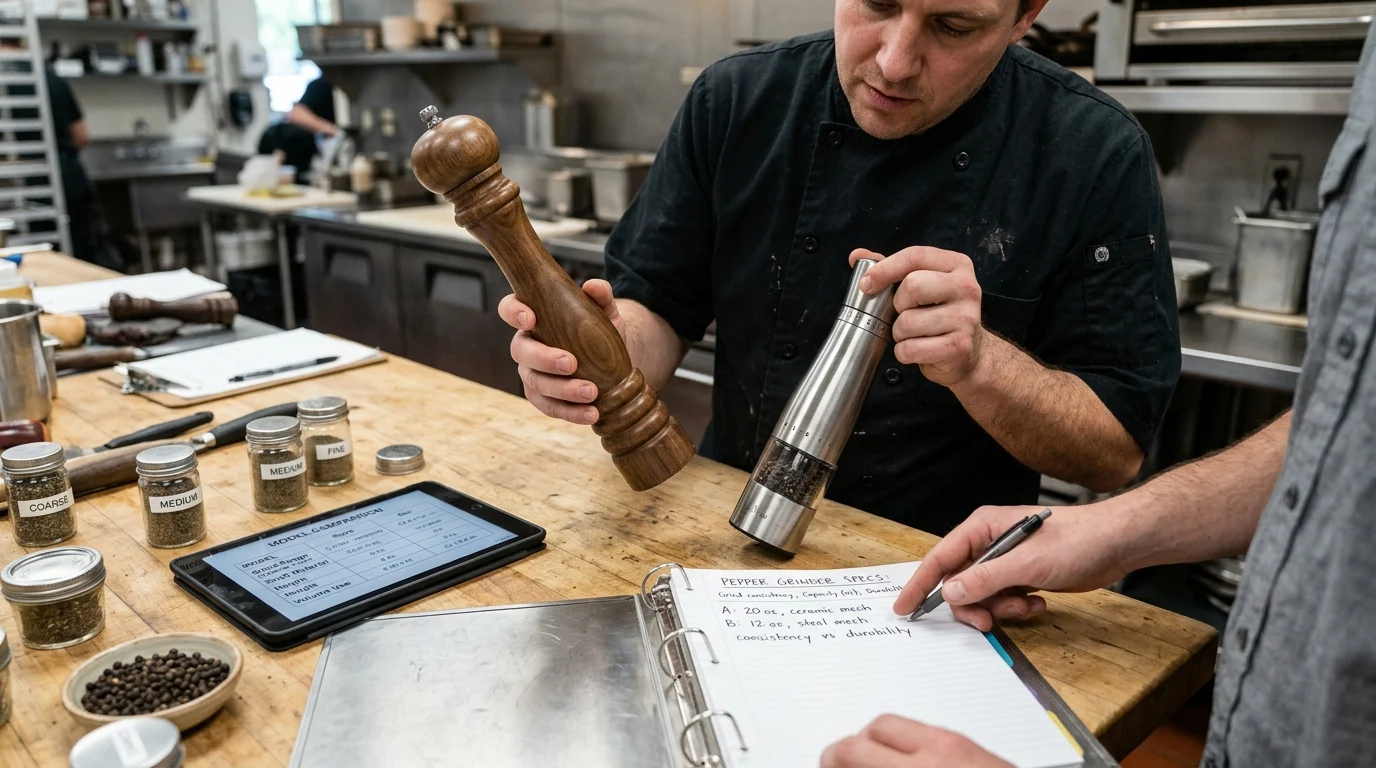
Understanding the mechanical specifications and material science behind grinding equipment ensures the selected units can withstand daily commercial rigors. Procurement teams must scrutinize internal components, grind-adjustment ranges, and retention rates at coarse settings rather than relying solely on exterior casing designs.
Manual, Electric, and Bulk Grinding Systems
Commercial kitchens generally utilize three categories of grinding systems: manual, electric, and bulk. Manual mills offer tactile control and are standard for FOH service, typically featuring hopper capacities of 20 to 50 grams. For BOH efficiency, a battery-operated unit from a commercial pepper mill manufacturer provides essential one-handed operation, allowing chefs to stir or sauté simultaneously. When evaluating electric models, consider battery life and recharge cycles to ensure they last through a full shift.
For extreme volume, such as banquet prep or commissary kitchens, bulk motorized grinding systems are necessary. These stationary units boast hopper capacities exceeding 500 grams and can typically process a benchmark of 1.5 kilograms of spices per hour, utilizing heavy-duty motors designed for continuous duty cycles without thermal overload.
Materials, Burr Type, Capacity, and Ergonomics
The core of any grinder is its burr mechanism. As detailed in the table below, high-carbon steel is ideal for dry, pepper-only use, while stainless steel suits high-moisture areas. Ceramic burrs offer an approximate hardness rating of 9 on the Mohs scale, providing excellent longevity and zero corrosion for mixed spice use.
When outfitting a kitchen, specifying a commercial salt and pepper grinder with a dual-head design or ceramic core guarantees cross-compatibility. While dual-head models feature entirely separate chambers to prevent physical mixing, staff must remain vigilant to avoid dispensing the wrong seasoning. For strictly high-volume pepper needs, dedicated single-head units are often recommended over dual models to eliminate this risk entirely. Sourcing from an established pepper grinder manufacturer ensures access to ergonomic features like adjustable LED lighting, transparent reservoirs, and crucial long-term support, such as multi-year warranties and the availability of spare burrs over a three-to-five-year lifecycle.
| Burr Material | Mohs Hardness | Corrosion Resistance | Best Commercial Application |
|---|---|---|---|
| High-Carbon Steel | 6.0 – 6.5 | Low (Requires dry use) | BOH pepper-only precision grinding |
| Advanced Ceramic | ~9.0 | Extremely High | FOH/BOH versatile salt & spice use |
| Stainless Steel | 5.5 – 6.0 | High | General purpose, high-moisture areas |
Evaluate Cost, Durability, and Compliance
Strategic procurement requires evaluating equipment beyond the initial purchase price. Decision-makers must analyze the Total Cost of Ownership (TCO), long-term durability, and adherence to stringent food safety and sanitation compliance standards, such as NSF certification for food-contact materials and cleanability under HACCP protocols.
Test Performance Before Buying
Prior to mass deployment across a restaurant group, operators should test equipment under simulated service conditions. Requesting evaluation units from a commercial pepper grinder factory allows chefs to assess grind consistency, structural integrity, and whether the units meet regional health regulations.
As a standard industry benchmark, a high-quality commercial mechanism should yield approximately 90% uniform particle size (often measured via standard sieve analysis) at medium-coarse settings. Inconsistent grinds not only affect flavor dispersion but also indicate poor burr alignment. Testing should also verify that adjustment knobs maintain their position after extended use, ensuring calibration does not drift during a busy service.
Balance Throughput, Maintenance, and Total Cost
Calculating Total Cost of Ownership (TCO) reveals that investing in commercial-grade units drastically reduces long-term expenses. For an illustrative scenario, consider a $20 domestic grinder that fails and requires replacement every two months due to stripped gears. Factoring in the labor cost of constant replacement and downtime, this costs significantly more annually than a $150 commercial unit engineered for a three-to-five-year lifecycle—even when accounting for replacement batteries and spare burrs for the commercial model.
Furthermore, commercial environments demand highly reliable equipment—often targeting defect rates below 0.5% as a standard benchmark—to prevent service disruptions. Maintenance protocols and compliance also factor into TCO; grinders that can be easily disassembled and sanitized to meet HACCP standards reduce labor costs. Buyers must also note dishwasher versus hand-wash constraints, as many burr mechanisms cannot be submerged.
Key Takeaways
- Treat pepper grinding as high-volume when usage reaches 2.5 to 5 kilograms per week or service exceeds 500 covers.
- Choose front-of-house grinders that combine visual appeal, jam-free dispensing, smooth operation, and noise levels under 60 dB.
- Select back-of-house electric grinders with one-handed operation, strong battery life, and IPX4 or better moisture protection.
- Use manual mills with 20 to 50 gram hoppers for table service, but choose bulk systems with 500 gram-plus hoppers for commissary or banquet prep.
- Prioritize commercial burr mechanisms because they maintain grind consistency, reduce heat buildup, and withstand repeated daily use.
Frequently Asked Questions
What counts as high-volume pepper grinding in a restaurant?
A practical benchmark is 2.5 to 5 kilograms of whole peppercorns per week or more than 500 covers per service. At that level, domestic grinders often wear out quickly and produce inconsistent grind sizes.
Should a restaurant choose manual or electric pepper grinders?
Manual grinders suit front-of-house table service where presentation and control matter. Electric grinders are better for back-of-house stations because they allow one-handed operation, improve speed, and reduce staff fatigue during busy service.
What noise level is best for front-of-house electric grinders?
For dining-room use, electric grinders operating under 60 dB are generally preferred. This helps staff provide table-side seasoning without disrupting conversation or the overall guest experience.
Why does burr quality matter in a commercial pepper grinder?
The burr controls grind consistency, durability, and heat buildup. Commercial-grade burrs are better suited to frequent use, helping preserve pepper aroma while reducing jams, stripped gears, and uneven particle sizes.
What capacity should a commercial pepper grinder have?
Manual front-of-house mills commonly hold 20 to 50 grams. Bulk grinding systems for banquet prep or commissary kitchens may exceed 500 grams and process around 1.5 kilograms of spices per hour.