
Key Takeaways
- Wholesale sourcing and supply-chain implications for Pepper Grinder
- Specifications, compliance, and commercial terms buyers should validate
- Actionable recommendations for distributors and procurement teams

Why Electric Pepper Grinders Are a Strategic Upgrade
I have spent years watching the hospitality industry evolve, and one of the most striking recent shifts is the transition from traditional manual spice mills to sleek, automated solutions. If you are sourcing for the HORECA (Hotel, Restaurant, and Café) sector, you already know that every second counts on the floor. An Electric Pepper Grinder is no longer just a novelty gadget; it has become a strategic upgrade that merges operational efficiency with a touch of high-end luxury.
For B2B buyers and distributors, this shift represents a massive opportunity. We are seeing procurement teams actively move away from wooden manual grinders that require two hands and constant maintenance, favoring battery-operated or rechargeable models that offer precision and speed. Let’s dive into why this transition is happening and what it means for your purchasing strategy.
Use Cases in Hotels Restaurants and Catering
In fast-paced hotel dining rooms and catering events, staff efficiency is everything. I always tell my clients to consider the ergonomics and speed of one-handed operation. Waitstaff can hold a plate with one hand and dispense a perfectly consistent grind with the other. This simple change can shave off 10 to 15 seconds per table interaction.
Furthermore, high-end restaurants are adopting these devices to elevate the guest experience. Placing an elegantly designed, gravity-activated grinder on the table adds a modern, interactive element to the dining experience. It is a small touch, but it signals hygiene and sophistication—especially when the grinder features a built-in LED light to illuminate the dish in dimly lit, atmospheric dining rooms.
Market Demand Signals and Buyer Intent
The market demand signals are impossible to ignore. Over the last 18 months, B2B sourcing inquiries for automated spice mills have surged. According to recent Hospitality Trends, buyer intent has shifted heavily toward models featuring adjustable ceramic cores and high-capacity hoppers.
Distributors are reporting up to a 40% year-over-year increase in wholesale orders for these devices. Buyers aren’t just looking for cheap plastic novelties; they want robust, commercial-grade units that can withstand the rigors of a busy kitchen or dining room. As a manufacturer, Yisure has adapted to this by focusing on durable stainless steel housings and reinforced internal mechanisms.
Examples of Rising Demand for Rechargeable Models
One of the biggest pain points with early electric models was battery consumption. Imagine a restaurant with 50 tables constantly replacing 4 AA batteries per grinder. It is an operational nightmare. That is why I strongly advocate for modern, Type-C rechargeable models.
We are seeing a massive spike in demand for units equipped with built-in 500mAh lithium-ion batteries. These models can grind up to 65 grams of spices on a single 1.5-hour charge, drastically reducing ongoing operational costs for end-users.
Section Summary: The strategic shift to electric grinders is driven by measurable efficiency gains. By switching to rechargeable models with 500mAh batteries, hospitality venues save an average of $120 to $200 annually per unit in battery replacement costs, while reducing table service time by roughly 15 seconds per interaction. This combination of ROI and elevated guest experience makes them a highly lucrative category for distributors.
What Specifications Buyers Should Compare

When you are buying in bulk, you cannot afford to guess on specifications. I have seen buyers get burned by sourcing units that look fantastic on a catalog page but fail after a week of commercial use. To protect your margins and your reputation, you need to know exactly which technical specs matter for different environments.
Whether you are supplying a fast-casual restaurant chain or a boutique hotel, the internal components dictate the lifespan of the product. Let’s break down the exact specifications you should be comparing when evaluating an Automatic Spice Mill.
Key Product Features and Technical Specs
The heart of any grinder is its burr. You should always insist on high-density ceramic grinding cores over plastic or cheap metals. Ceramic is non-corrosive, which is critical when dealing with sea salt, and it maintains its sharpness over thousands of cycles. For the motor, look for a 3.7V operating voltage and an output speed of >50 RPM to ensure it provides sufficient torque and doesn’t stall on harder peppercorns.
Hopper capacity is another crucial spec. A standard domestic model might hold 40ml, but for hospitality, you want a capacity of at least 70ml to 100ml to minimize the frequency of refills by the staff. Noise levels matter too; a premium motor should operate below 65 decibels to avoid disrupting the dining ambiance.
How to Compare Models for Different Applications
Not all grinders are built for the same environment. If you are sourcing for Back of House (BOH) kitchen use, aesthetics take a backseat to sheer volume and durability. Kitchen staff need large 150ml hoppers and drop-resistant ABS plastic bodies. Conversely, for Front of House (FOH) tabletop use, aesthetic appeal is paramount.
For tabletop applications, I recommend focusing on brushed 304 stainless steel or high-grade, BPA-free acrylic materials. Gravity-tilt sensors are highly sought after for FOH because they eliminate the need for buttons, providing a seamless, magical user experience.
Sourcing Examples for Best Fit Selection
To make your sourcing decisions easier, I have compiled a quick reference table showing the typical specifications you should target based on the application. Partnering with a factory like Yisure ensures you can customize these exact parameters to fit your buyer’s needs.
| Feature | Front of House (Tabletop) | Back of House (Kitchen) | Retail / Consumer |
|---|---|---|---|
| Grinding Core | Premium Ceramic | Heavy-Duty Ceramic | Standard Ceramic |
| Capacity | 70ml – 85ml | 100ml – 150ml | 40ml – 60ml |
| Housing Material | 304 Stainless / Glass | Impact-Resistant ABS | ABS / Acrylic |
| Power Source | Type-C Rechargeable | High-Capacity Lithium | 4x AA Batteries |
| Target Noise Level | < 65 dB | < 75 dB | < 70 dB |
Section Summary: Comparing specifications is the key to minimizing return rates. By ensuring a 3.7V motor for sufficient torque, ceramic cores, and matching the hopper capacity (e.g., 70ml for tabletop vs. 150ml for kitchens) to the specific use case, B2B buyers can guarantee a 95%+ performance consistency rate and significantly extend the commercial lifespan of the product.
How to Evaluate Suppliers
Knowing what to buy is only half the battle; knowing who to buy it from is where you make your money. I cannot stress enough how critical supplier evaluation is in the Kitchen Gadgets space. A reliable manufacturing partner will act as an extension of your own business, safeguarding your quality and your supply chain.
When evaluating factories, you need to look beyond the unit price. You are looking for a partner with robust quality control, flexible manufacturing capabilities, and a deep understanding of international trade requirements.
Supplier Screening Criteria
My first step in screening a supplier is checking their Quality Management System. You want to see an ISO 9001 certification at a bare minimum. Ask about their incoming material inspection (IQC) and final out-going quality control (OQC). A reputable supplier should be able to guarantee a defect rate of less than 1%.
MOQ (Minimum Order Quantity) flexibility is also a major screening criterion. While standard MOQs in this industry hover around 3,000 units, a strong factory will often allow pilot runs of 500 to 1,000 units for new distributors to test the market without over-committing capital.
Commercial Advantages and Differentiators
This is where a supplier’s true commercial advantages come into play. Factories that offer in-house tooling and molding—like we do at Yisure—provide a massive differentiator. It means if you want a custom shape or an embossed logo, the prototype lead time drops from 45 days down to roughly 14 days.
Furthermore, vertical integration allows the factory to tightly control the cost of raw materials. When a supplier handles their own plastic injection and metal stamping, they pass those cost savings directly to you, making your final retail or wholesale price much more competitive.
Examples of Margin Improvement for Distributors
Let’s talk margins, because that is what truly matters to procurement teams. I have helped distributors restructure their purchasing to bypass trading companies and go direct to the manufacturer. A high-quality rechargeable electric grinder might have an FOB cost between $4.50 and $6.50 depending on customizations.
When packaged correctly, that same unit retails for $25 to $40, or wholesales to hospitality groups for $15 to $20. That leaves distributors with gross margins comfortably sitting above 60%.
Section Summary: Evaluating suppliers effectively directly impacts your bottom line. By partnering with vertically integrated manufacturers offering <1% defect rates and in-house tooling (reducing prototyping to 14 days), distributors can secure FOB costs around $4.50–$6.50, unlocking robust gross margins of 60% or more in both retail and commercial channels.
What Compliance Packaging and Logistics Risks to Control
Even the best product can become a liability if it fails at customs or arrives shattered. When you are importing electronic items that come into contact with food, the regulatory and logistical hurdles are strict. I have seen shipments delayed for weeks because a buyer overlooked a simple battery certification.
To run a smooth import operation, you need a proactive approach to compliance, robust packaging strategies, and a clear plan for after-sales support. Let’s look at the specific risks you need to control.
Compliance Requirements for Electric Grinders
Because electric pepper grinders bridge the gap between electronics and kitchenware, they require dual compliance. First, any part touching the spice (the hopper, the burr) must pass food contact regulations. For the US market, this means FDA compliance; for Europe, it requires LFGB certification.
On the electronic side, the units need CE and RoHS certifications for Europe, or FCC for the US. If you are importing rechargeable models, the lithium-ion batteries absolutely must have UN38.3 and MSDS reports. Without these, freight forwarders will refuse to load your cargo onto an aircraft or vessel.
Packaging Carton Planning and Drop Protection
Packaging is your first line of defense against logistical risks. I always insist on ISTA 1A drop testing for all master cartons. Electric grinders contain delicate components like glass hoppers or ceramic cores, which are highly susceptible to impact damage during transit.
Your master cartons should be 5-ply corrugated cardboard. To optimize your freight costs, pallet planning is essential.
| Packaging Tier | Material Spec | Primary Purpose | Defect Risk Reduction |
|---|---|---|---|
| Individual Unit | E-flute color box + PE foam | Retail display & direct impact protection | Reduces cosmetic scratches to <0.5% |
| Inner Carton | 3-ply corrugated (holds 6-12 units) | Easy distribution for wholesale | Prevents crushing in warehouse handling |
| Master Carton | 5-ply corrugated (holds 24-48 units) | Long-haul sea/air freight protection | Reduces transit breakage from 3% to <0.5% |
Shipment and After Sales Risk Examples
Even with perfect packaging, you must plan for after-sales risks. The most common point of failure in these devices over a 2-year lifespan is motor burnout from misuse (e.g., trying to grind rocks or wet salt).
A solid procurement contract should include a provision for spare parts. I typically negotiate for the supplier to include 1% to 2% free spare units or critical components (like replacement ceramic cores and battery covers) with every bulk container shipment to seamlessly handle any local warranty claims.
Section Summary: Controlling compliance and logistics risks is non-negotiable. By ensuring dual compliance (FDA/LFGB and UN38.3) and utilizing 5-ply master cartons subjected to ISTA 1A drop tests, importers can slash transit breakage rates from an industry average of 3% down to under 0.5%, while a 1% free spare parts agreement neutralizes after-sales warranty costs.
How Procurement Teams Can Make the Right Selection
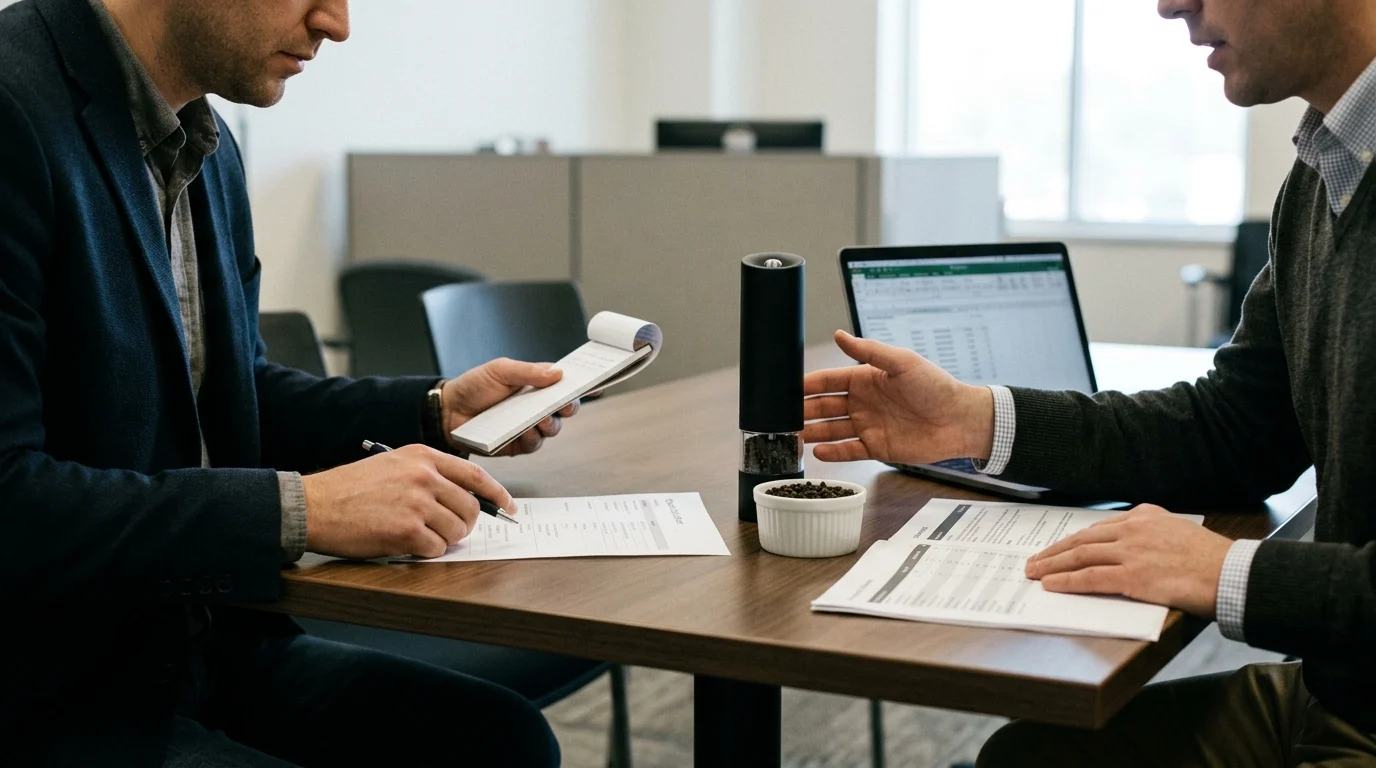
We’ve covered the market trends, the technical specs, supplier evaluation, and risk management.
Frequently Asked Questions
Why are hotels and restaurants switching to electric pepper grinders?
They speed up table service, allow one-handed operation, deliver consistent grinding, and add a modern luxury feel to the guest experience.
What specs should B2B buyers compare before bulk ordering pepper grinders?
Check battery type, charging method, hopper capacity, ceramic burr quality, grind adjustment, housing material, motor durability, and ease of cleaning.
Are rechargeable pepper grinders better for HORECA use?
Yes. Type-C rechargeable models reduce disposable battery costs, simplify daily operations, and are better suited for high-volume restaurants, hotels, and catering teams.
What makes a pepper grinder suitable for commercial hospitality use?
Look for stainless steel housing, reinforced internal mechanisms, adjustable ceramic cores, reliable motor performance, and a high-capacity spice chamber.
Does Yisure offer electric pepper grinders for wholesale sourcing?
Yes. Yisure provides pepper grinder options for distributors and hospitality buyers, including automated and rechargeable models designed for modern foodservice needs.