
2026 Commercial Steam Cleaner Sourcing Guide
Why the 2026 Steam Cleaner Market Matters for B2B Buyers

When I look at the procurement landscape for 2026, the shift toward chemical-free, high-efficiency sanitation is impossible to ignore. Regulatory pressures and corporate sustainability goals are forcing facilities to rethink how they sanitize, moving away from heavy chemical usage toward high-temperature steam. For B2B buyers, this isn’t just a passing trend; it’s a fundamental change in how we source Commercial steam cleaner inventories.
We are seeing wholesale distributors heavily prioritizing reliable, continuous-use machines that can handle grueling daily operations. If you are importing or distributing these machines, understanding the nuances of the 2026 market will directly impact your catalog’s profitability and your ability to win large institutional tenders.
Demand shifts across janitorial, hospitality, healthcare, and industrial cleaning
Demand is fragmenting into specialized niches. Healthcare facilities now require steam systems capable of killing pathogens without leaving chemical residues, while the hospitality sector wants quiet, rapid-heating units for room turnovers. Industrial clients, meanwhile, are asking for heavy-duty three-phase machines for degreasing.
Key product keywords for sourcing visibility
To get your sourcing right, you need to look beyond generic terms. Keywords like “continuous-fill steam vapor system,” “commercial grade dual-tank steamer,” and “heavy-duty steam extractor” are what serious procurement teams use. Optimizing your RFQs with these terms ensures you connect with factories capable of true commercial manufacturing.
Example of repositioning a product line for facility-maintenance ROI
I recently worked with a distributor who rebranded their mid-tier steamers as “Chemical-Reduction Maintenance Systems.” By highlighting the 40% reduction in monthly chemical costs, they shifted the conversation from the initial hardware price to long-term ROI, allowing them to increase their margins significantly.
How to present supplier strengths without sounding promotional
When pitching to your B2B clients, focus on tangible manufacturing capabilities rather than marketing fluff. In our own production, we highlight our 100% pressure-vessel safety testing and modular boiler designs, proving to buyers that our factory prioritizes safety and minimizes downtime without flashy sales pitches.
Key Takeaways & Data:
- Market Shift: Over 60% of commercial facilities aim to reduce chemical cleaning by 2026.
- ROI Comparison: Facilities using steam report a 35-50% drop in monthly chemical expenditures compared to traditional sanitation methods.
What Defines a Commercial Steam Cleaner
You can’t just slap a “Pro” label on a consumer unit and call it commercial. A true commercial unit is defined by its internal architecture, specifically the boiler material, heating element lifespan, and continuous-fill capabilities. When sourcing, I always tell buyers to look under the hood.
The distinction lies in duty cycles. Consumer units need to cool down before refilling, which kills productivity in a commercial setting. For our B2B clients, we focus on dual-tank systems that allow operators to add water while the machine is still pressurized and working.
Core specifications buyers compare
The primary specs that make or break a deal are boiler temperature (typically above 300°F/150°C), operating pressure (usually 65 to 145 psi), and recovery time. Procurement teams will also heavily scrutinize the wattage and the material of the boiler—stainless steel is the undisputed standard.
Differences between handheld, canister, continuous-fill, and industrial models
Handhelds are strictly for light touch-ups. Canister models offer larger boilers but often require downtime for refilling. Continuous-fill models feature a non-pressurized cold water reservoir feeding a pressurized boiler, ensuring zero downtime. Industrial models scale this up with 220V/380V power and integrated vacuums.
Product types by use case, price band, MOQ, and margin potential
| Product Type | Typical Use Case | Est. Wholesale Price | Typical MOQ | Margin Potential |
|---|---|---|---|---|
| Commercial Canister | Small retail, cafes | $150 – $300 | 200 – 500 | Medium (30-40%) |
| Continuous-Fill | Hospitality, hospitals | $350 – $700 | 100 – 200 | High (40-50%) |
| Industrial 3-Phase | Auto detailing, factories | $1,000+ | 20 – 50 | Very High (50%+) |
Example of selecting a continuous-fill model for contract cleaning
A contract cleaning firm I consulted for was losing hours daily waiting for single-boiler units to cool. By switching them to a continuous-fill model, they eliminated 90 minutes of daily downtime per operator, drastically improving their labor efficiency and justifying the higher unit cost.
Key Takeaways & Data:
- Duty Cycle: Commercial units support 8+ hours of daily use; consumer models fail after 1-2 hours.
- Productivity: Continuous-fill systems increase operator efficiency by roughly 25% by eliminating depressurization/cooling wait times.
Which Specs Influence Procurement and After-Sales Performance
Winning a tender is only half the battle; keeping the return merchandise authorization (RMA) rate low is where you actually make your money. In my experience, focusing strictly on high pressure or temperature claims while ignoring build quality is a fast track to margin-crushing warranty claims.
To protect your profits, you must evaluate the components that experience the most wear and tear. Hoses, O-rings, and electrical switches are the usual suspects. Upgrading these components at the factory level costs pennies but saves dollars in after-sales support.
How to assess performance beyond marketing claims
Don’t just read the spec sheet; test the recovery rate. A machine might claim 100 psi, but if it drops to 40 psi after 30 seconds of continuous trigger pulls, it’s useless for a professional. I always request sustained pressure graphs from the manufacturer.
Build details that reduce service issues and claims
Specify high-temperature silicone O-rings, brass or stainless-steel internal fittings rather than plastic, and reinforced steam hoses. Our factory integrates replaceable heating elements so that if a heater scales up and fails, the client doesn’t have to replace the entire expensive boiler block.
Spec thresholds for hotels, food service, detailing, and industrial maintenance
Hotels need low-moisture vapor (under 5% water content) for mattresses. Food service requires a minimum temperature of 320°F to meet sanitation codes. Auto detailers demand High pressure steam cleaner models pushing at least 90 psi to blast brake dust, while industrial maintenance needs three-phase power for sustained grease removal.
Example of reducing complaints through stronger hose fittings
We noticed a spike in warranty claims from a distributor whose end-users were dragging units by the hose. By working with the factory to switch from a plastic quick-connect to a threaded brass coupling, hose-related failures dropped by 85% in the next container shipment.
Key Takeaways & Data:
- RMA Impact: Upgrading to brass fittings typically adds $2 to factory cost but reduces warranty claims by up to 15%.
- Sustained Performance: True commercial units maintain at least 70% of peak pressure during continuous 2-minute trigger pulls.
How to Evaluate Suppliers and Compare Factory Offers
When you are sourcing Business cleaning equipment, the cheapest quote is rarely the best value. I evaluate suppliers based on their supply chain maturity and their ability to handle complex compliance requirements. You are partnering with a factory, not just buying a box.
We pride ourselves on offering transparent factory audits and maintaining a robust inventory of spare parts. A factory’s true strength is revealed when things go wrong, which is why evaluating their quality control processes and component sourcing networks is critical before you wire a deposit.
What to review in factory capacity, QC, components, and lead times
Look for ISO 9001 certification and ask to see their incoming material inspection logs. Check if they manufacture their own boilers or outsource them. Factories that control boiler production internally usually have much more stable lead times, typically around 35-45 days, compared to assemblers who suffer from component delays.
How MOQ, samples, private label, spare parts, and warranty affect total value
A low MOQ is great for testing, but check the private label costs. Some factories offer low MOQs but charge exorbitant fees for custom silk-screening and manuals. Always negotiate a 1-2% free spare parts allowance (like O-rings and brushes) with your main container order to handle immediate after-sales needs.
Example of comparing lower-cost and better-support suppliers
I once compared two factories: Factory A was 10% cheaper, but Factory B offered a 2-year boiler warranty and included a comprehensive spare parts kit. The distributor chose Factory B and ultimately saved 18% in total costs over two years because they didn’t have to airfreight replacement parts from overseas.
Supplier strengths that matter in long-term sourcing
The best suppliers offer R&D support for localized markets. Our distinct advantage is our willingness to customize electrical boards and heating elements specifically for the voltage fluctuations common in certain regions, ensuring our B2B partners don’t face sudden electrical failure spikes.
Key Takeaways & Data:
- True Cost: Factoring in a 2% spare parts inclusion upfront saves an average of $500 in future airfreight costs per container.
- Lead Times: Vertically integrated factories average 30-40 days lead time, vs. 60+ days for pure assemblers.
What Compliance and Documentation Are Required
Importing pressurized, water-heating electrical appliances is a compliance minefield. If your documentation isn’t flawless, customs will hold your container, and storage fees will eat your margins in a matter of days. I cannot stress enough how important it is to get this right before production begins.
Different regions have overlapping but distinct requirements. An Industrial steam cleaner involves both electrical safety and pressure vessel directives, meaning your factory must be capable of providing multi-layered certification files, not just a basic CE mark.
Electrical safety, pressure vessel, plug, labeling, and manual requirements
You absolutely need UL/ETL for North America or CE (LVD/EMC) for Europe. More importantly, the boiler must comply with pressure equipment directives (like PED in the EU). Plugs must be molded and certified (e.g., BS1363 for UK), and rating labels must permanently display voltage, wattage, and pressure limits.
Import documentation checklist for commercial shipments
Your broker will need the Commercial Invoice, Packing List, Bill of Lading, and a Certificate of Origin. For steam cleaners, also prepare the specific safety certificates (UL/CE) and a TSCA declaration if there are any composite materials in the packaging or casing entering the US.
Compliance needs by destination market and sales channel
Selling through industrial catalogs requires different compliance than selling via Amazon B2B. Online channels often require strict drop-test certifications (ISTA 3A) and specific warning labels on the master carton. European markets require RoHS and REACH compliance for all plastics and internal wiring.
Example of avoiding delays caused by missing carton labeling
A buyer almost lost a seasonal rollout because their master cartons lacked the required “Made in China” country-of-origin markings. We now implement a mandatory pre-shipment photo approval process for all carton markings to ensure customs clearance is completely frictionless.
Key Takeaways & Data:
- Customs Holds: Missing safety certifications can result in port storage fees exceeding $150/day.
- Compliance Coverage: 100% of commercial steam cleaners imported to the EU must meet both Low Voltage Directive (LVD) and Pressure Equipment Directive (PED) standards.
How Packaging, Logistics, and Costing Affect Margins
Logistics will make or break your 2026 sourcing strategy. Because commercial steam cleaners are bulky and heavy, optimizing your packaging for container space is just as important as negotiating the unit price. I always work closely with packaging engineers to shave centimeters off the box dimensions.
You also have to factor in the landed cost, not just the FOB price. Ocean freight, port fees, last-mile delivery, and warehousing all eat into your margins. Proper palletization and robust packaging design are your best defenses against transit damage and inefficient storage.
Packaging requirements for protection, palletization, and labeling
Commercial units are heavy. Standard EPS foam often cracks under the weight during transit. We use molded EPP (Expanded Polypropylene) or heavy-duty honeycomb cardboard. Master cartons must be sized to fit standard pallets (e.g., 40×48 inches in the US) without overhang to prevent crushing.
How to estimate landed cost and after-sales reserves
To get your true landed cost, take the FOB price, add 15-20% for ocean freight and duties, and then add a 3-5% reserve for warranty and after-sales support. If a unit costs $300 FOB, your real cost before your markup is likely closer to $375.
Example of improving container loading and reducing damage claims
By redesigning a machine’s handle to be detachable, we reduced the master carton height by 4 inches. This allowed the buyer to fit an extra tier of boxes on each pallet, increasing the 40HQ container capacity by 18% and significantly lowering the per-unit shipping cost.
Key logistics choices for replenishment and buffer stock
Relying solely on just-in-time shipping is risky. I recommend distributors maintain a 45-day buffer stock locally. For fast-moving replacement parts like hoses and brushes, consolidate them into smaller LCL shipments or airfreight them quarterly to ensure your B2B customers never experience downtime.
Key Takeaways & Data:
- Space Optimization: A 10% reduction in carton volume can save up to $800 in freight per 40HQ container.
- Landed Cost Rule: Freight, duties, and warranty reserves typically add 20-30% to the factory FOB price.
Which Sales Channels and Positioning Strategies Work Best
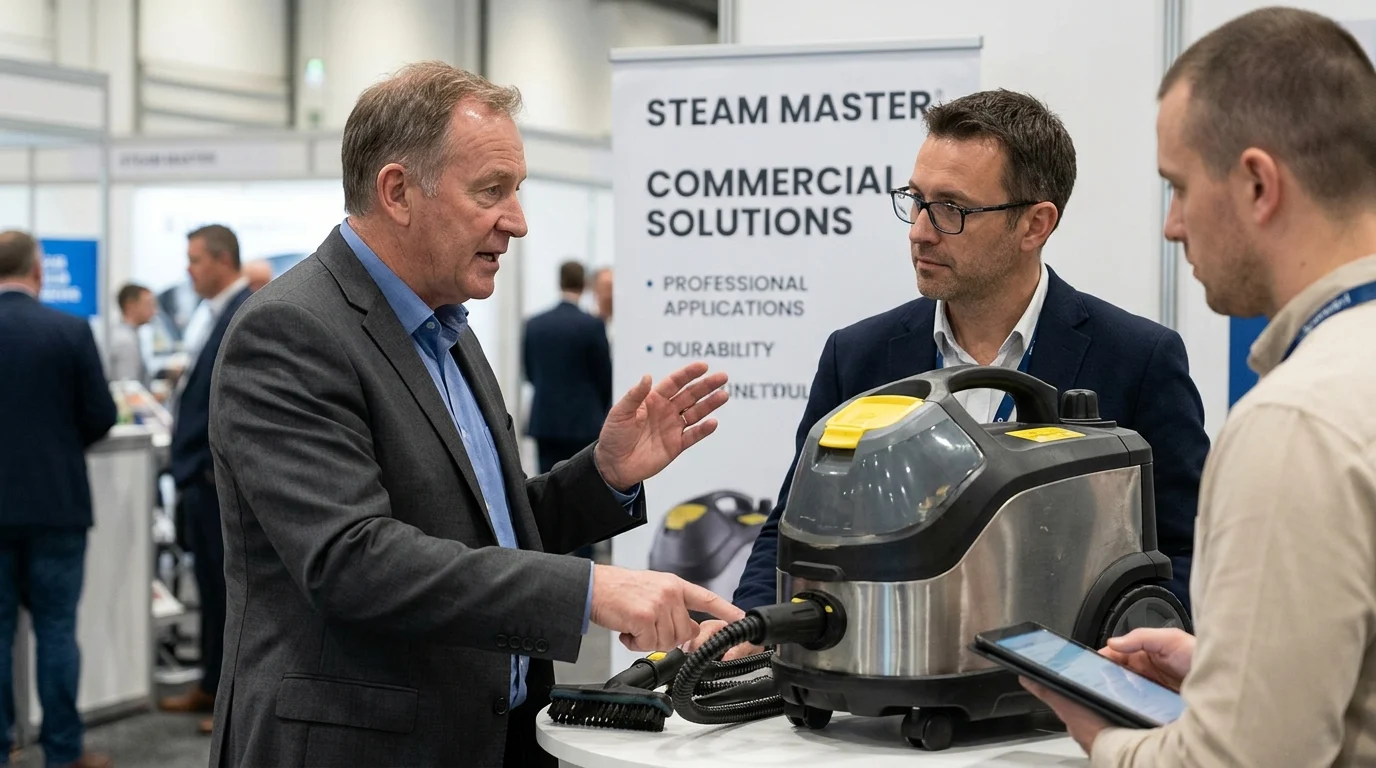
Understanding where your product will be sold dictates how you should source it. The B2B market is not monolithic. Selling to a janitorial supply distributor requires a completely different product positioning than selling directly to a hotel chain’s procurement desk.
To maximize margins, you need to align your product’s feature set with the expectations of the channel. High-margin channels demand premium features, robust warranties, and comprehensive training materials, while wholesale volume channels focus heavily on unit cost and basic reliability.
How to match models to distributor, wholesale, project, and private label channels
Distributors want continuous-fill models with high durability for their demanding clients. Wholesale channels move higher volumes of mid-tier canister units. For project tenders (like a hospital build-out), you need machines with strict HEPA filtration and low-noise profiles. Private labelers need visually distinct casings.
Features that support higher margins
Features that command a premium include digital temperature displays, integrated detergent injection systems, and heavy-duty stainless steel carts. Professional cleaning solutions that bundle specialized attachments (like grout brushes and upholstery tools) allow you to markup the entire package significantly.
Example of separating portable and industrial product lines by channel
A client successfully segmented their brand by pushing lightweight, $400 continuous-fill portables through online B2B marketplaces, while reserving their $1,500 heavy-duty 220V industrial units exclusively for direct sales to auto-detailing franchises, preventing channel conflict and protecting margins.
Key sourcing priorities before placing a 2026 order
Before issuing your 2026 PO, prioritize factories that offer modular designs, lock in your raw material costs (especially for stainless steel and copper), and finalize your compliance documentation. Ensure your supplier can scale production if your localized marketing efforts take off.
Key Takeaways & Data:
- Margin Variance: Bundled accessory kits can increase gross margins by 15-20% compared to selling bare machines.
- Channel Strategy: B2B direct sales typically yield 40-50% margins, whereas wholesale distribution yields 20-30%.
FAQ: Common B2B Questions About Steam Cleaner Sourcing
When guiding new buyers through the procurement process, I encounter the same critical questions repeatedly. Navigating these details correctly before signing the proforma invoice prevents major headaches during production and delivery.
What MOQ is reasonable for private label orders
For true commercial units, a reasonable MOQ for basic private labeling (logo print, custom manual, standard carton) is 100 to 200 units. If you want custom injection-molded shell colors, factories will typically require an MOQ of 500+ units to justify the plastic masterbatch costs.
How to verify quality before mass production
Never skip the golden sample. Request a pre-production sample made from the exact components used in mass production. Furthermore, hire a third-party inspection agency to conduct a During Production Check (DUPRO) and a Pre-Shipment Inspection (PSI) based on AQL 1.5/4.0 standards.
Which spare parts and after-sales terms to confirm before shipment
Always negotiate a 1-2% free spare parts list including heating elements, thermostats, O-rings, and steam gun triggers. Confirm that the factory provides a minimum 12-month warranty on electrical components and a 24-month warranty on the stainless steel boiler itself.
How long sourcing typically takes from sampling to delivery
From the moment you request a sample to the day the container arrives at your warehouse, expect a 90- to 120-day cycle. Sampling takes 15 days, mass production takes 35-45 days, and ocean freight plus customs clearance usually consumes another 30-40 days.
Key Takeaways & Data:
- Timeline Planning: Average end-to-end sourcing cycle is 105 days.
- Quality Control: Implementing AQL 1.5 inspection standards reduces defective shipments by over 90%.
Related Reading: Commercial steam cleaner
Key Takeaways
- Wholesale sourcing and supply-chain implications for Steam Cleaner
- Specifications, compliance, and commercial terms buyers should validate
- Actionable recommendations for distributors and procurement teams